procedo et parvam Troiam simulataque magnis
Pergama et arentem Xanthi cognomine rivum
agnosco, Scaeaeque amplector limina portae.
A title with one word struck out
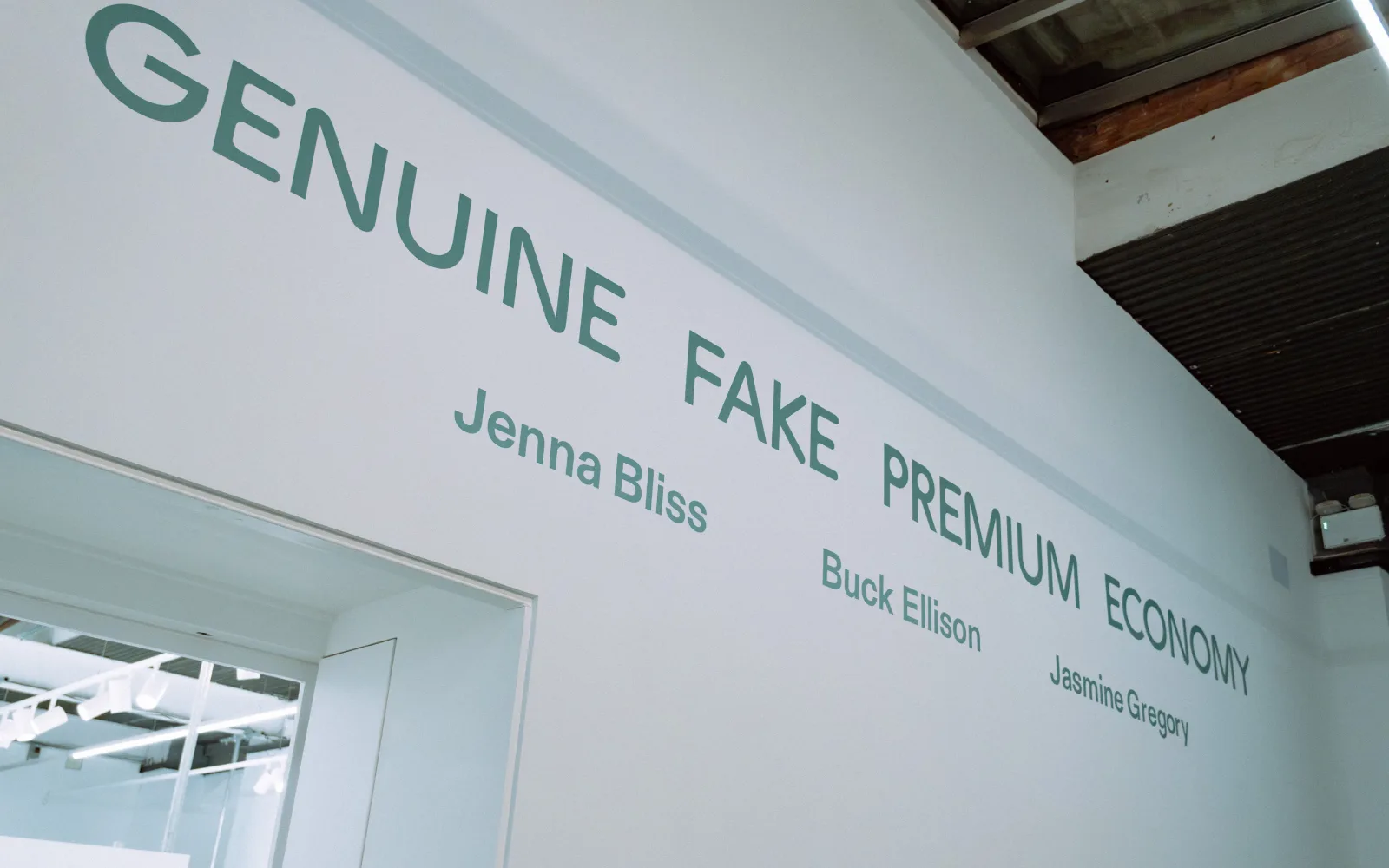
The panel at the entrance carries the title of the exhibition, and half of it has been crossed out in red. Erasing disappears beneath the stroke. To Create stays legible. The title already holds everything: the whole density of the paradox on which the artist's work rests, and on which rests the exhibition the Estorick Collection devotes to him in London.
More than thirty works are gathered in two of the Estorick's six rooms, spanning sixty-two years. It is, the Estorick states, the first exhibition a British institution has devoted to Emilio Isgrò, organised by the Estorick Collection of Modern Italian Art and the Fondazione Emilio Isgrò, in collaboration with the Consulate General of Italy in London. It is curated by Roberta Cremoncini, the Estorick's Director, whose catalogue essay follows the artist's paradox from its earliest and most private manifestations through to its largest and most openly political ones.
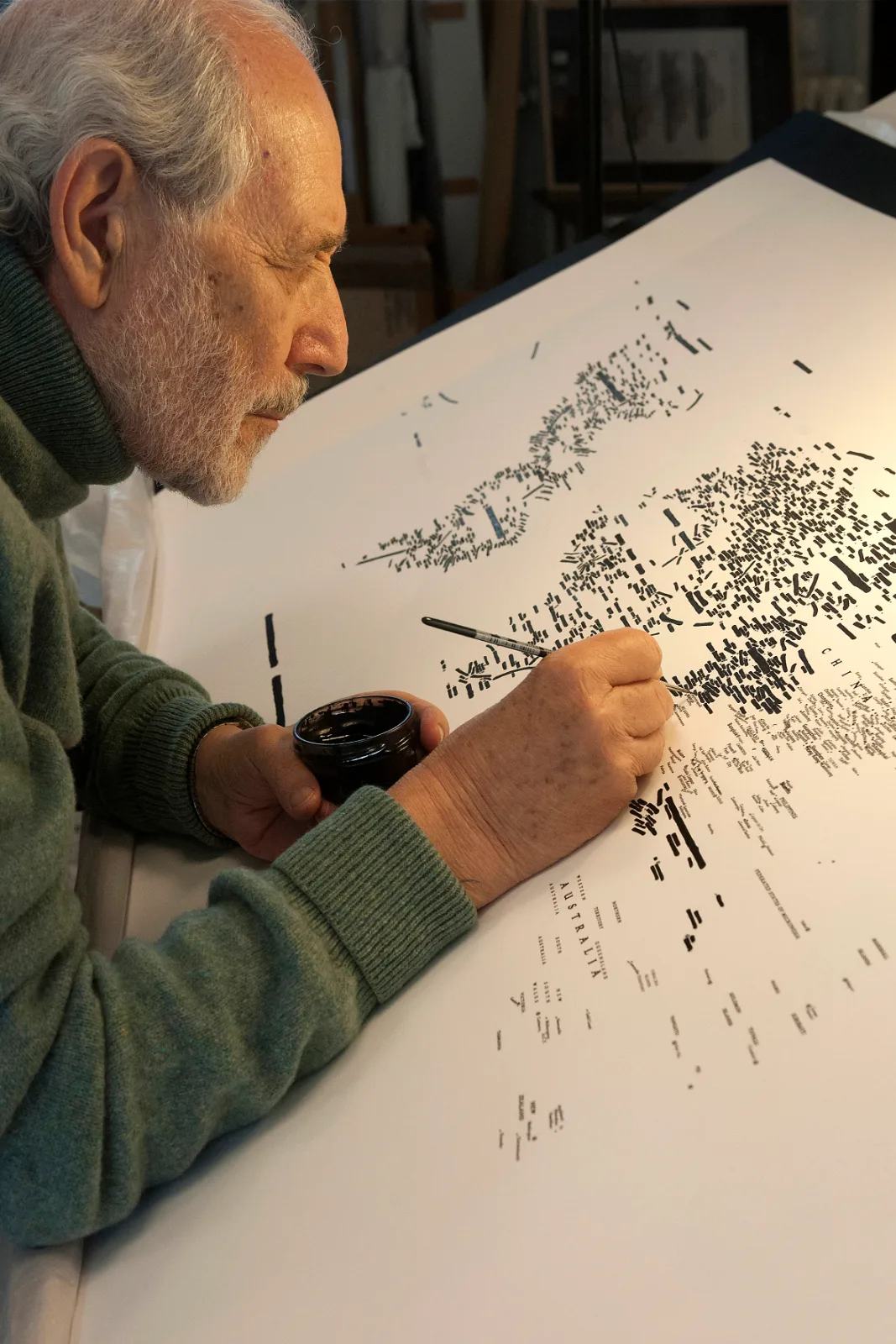
What we follow here is the trajectory of a single gesture: what the ink meets, in what order, and how it changes according to the surface it is laid on.
The first thing to go is a name
The two earliest works are from 1964, and they already carry everything that follows.
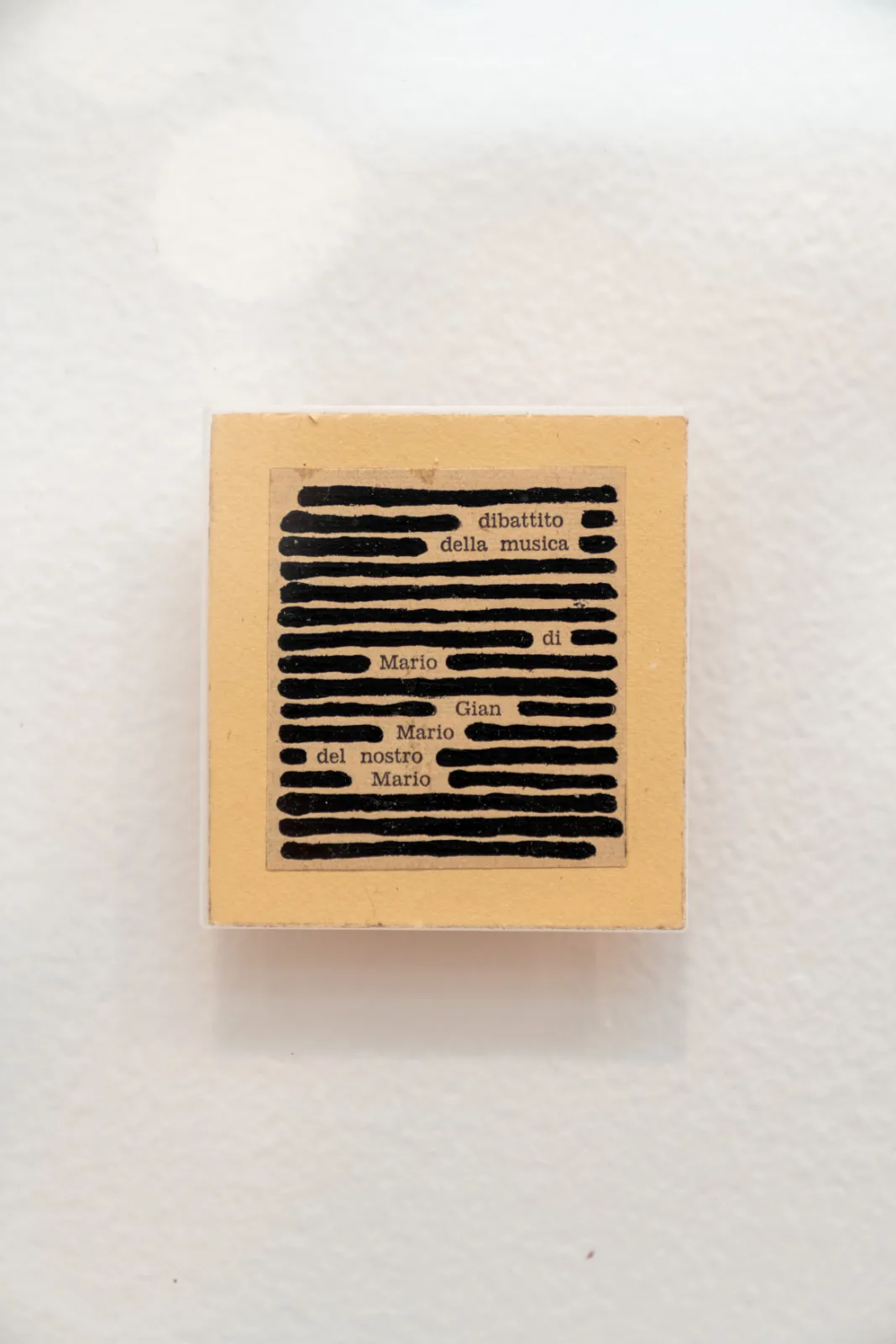
Cancellatura is very small: a clipping of printed text mounted on card and sealed in a block of plexiglass, its surface almost entirely covered in hand-applied ink. It gives its name to the technique of a lifetime. What survives the black most insistently is a first name, Mario, standing three times. Cremoncini reads the surviving words as a fragment of philosophical proposition quarried out of the banal setting that once surrounded it: a thought not illustrated but excavated from the rock of printed language.
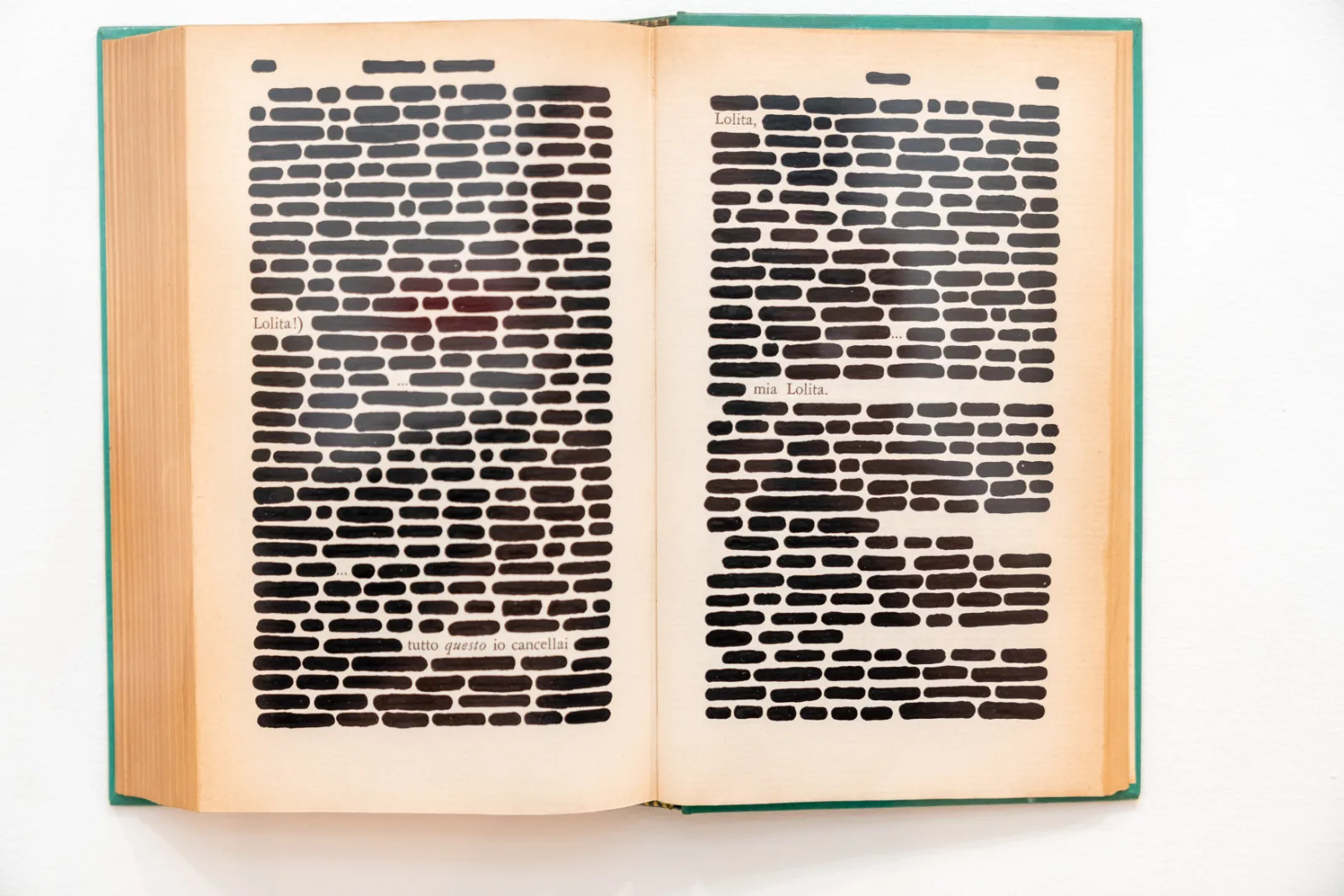
Lolita, from the same year, is an open copy of Nabokov's novel, its visible pages almost wholly inked, with three fragments left intact: the girl's name, twice, and the declaration that everything else has been erased. The choice of book, Cremoncini notes, is far from arbitrary. It is a novel about the violence of obsession, about a narrator who seeks to possess a person through the power of his own prose, and the erasure takes precisely that away: what is left is the name, and the act of erasing.
Two works, one year, the same thing spared. Giulietta (1967) repeats the operation and sharpens it: the left-hand page is left entirely blank, all the ink falls on the right, and out of it come two words of negation and, twice, the name. The negation and the name are the only things still able to speak.
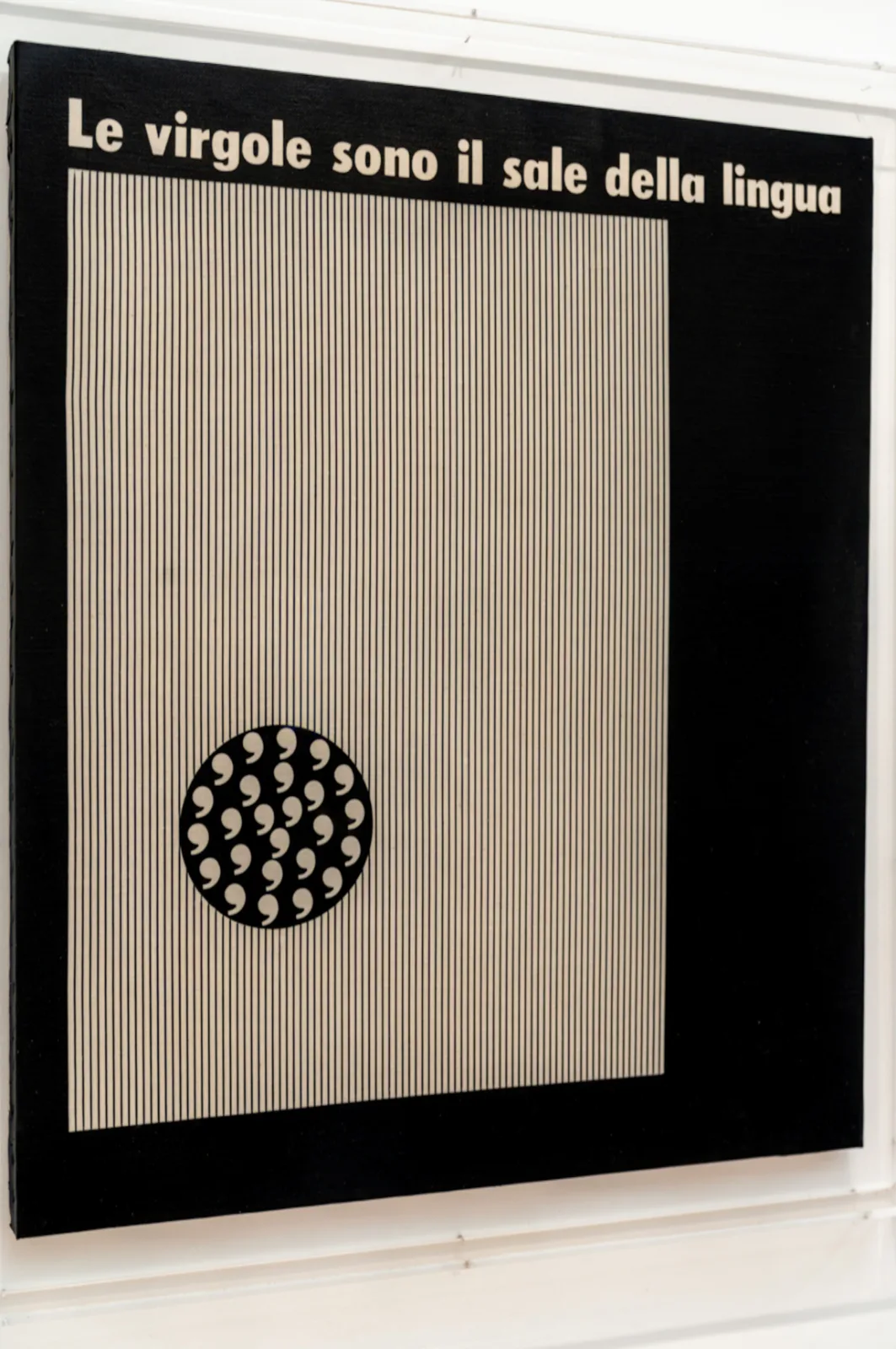
In the same span of years comes a work that does not erase at all, but declares. Le virgole (1967) is a canvas in which, above a field of close vertical lines, a single sentence runs in newspaper headline type: le virgole sono il sale della lingua, commas are the salt of language. Below it, a circle of commas hangs suspended, detached from any word. It is the one moment in the exhibition where Isgrò says openly what everything else practises in silence: the sense of a text does not lie in its words alone, it lies also in the marks that mean nothing by themselves and hold the others together. Anyone standing in front of an erasure is doing exactly this, reading what remains and rebuilding the connection.
From the page to the map
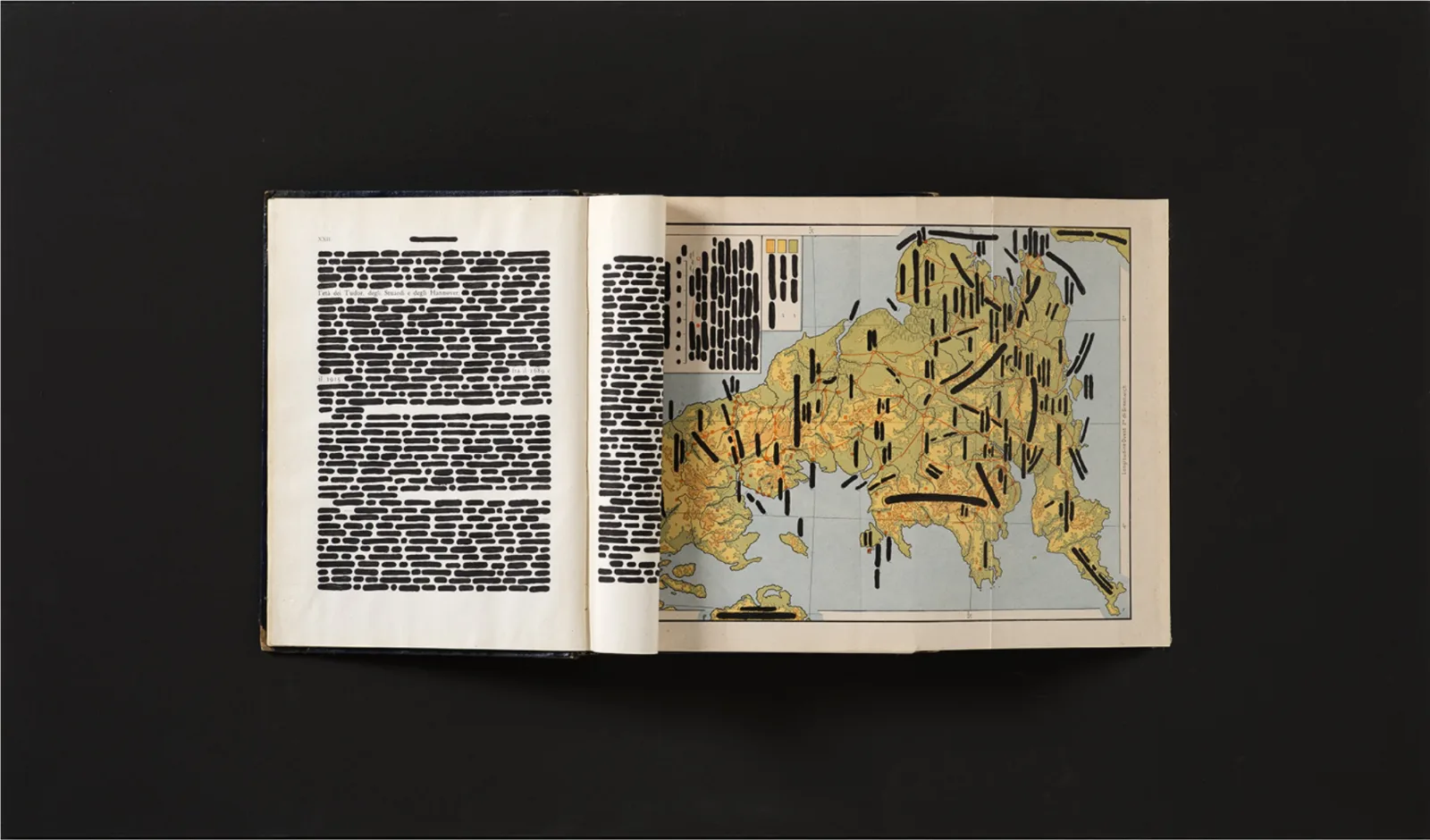
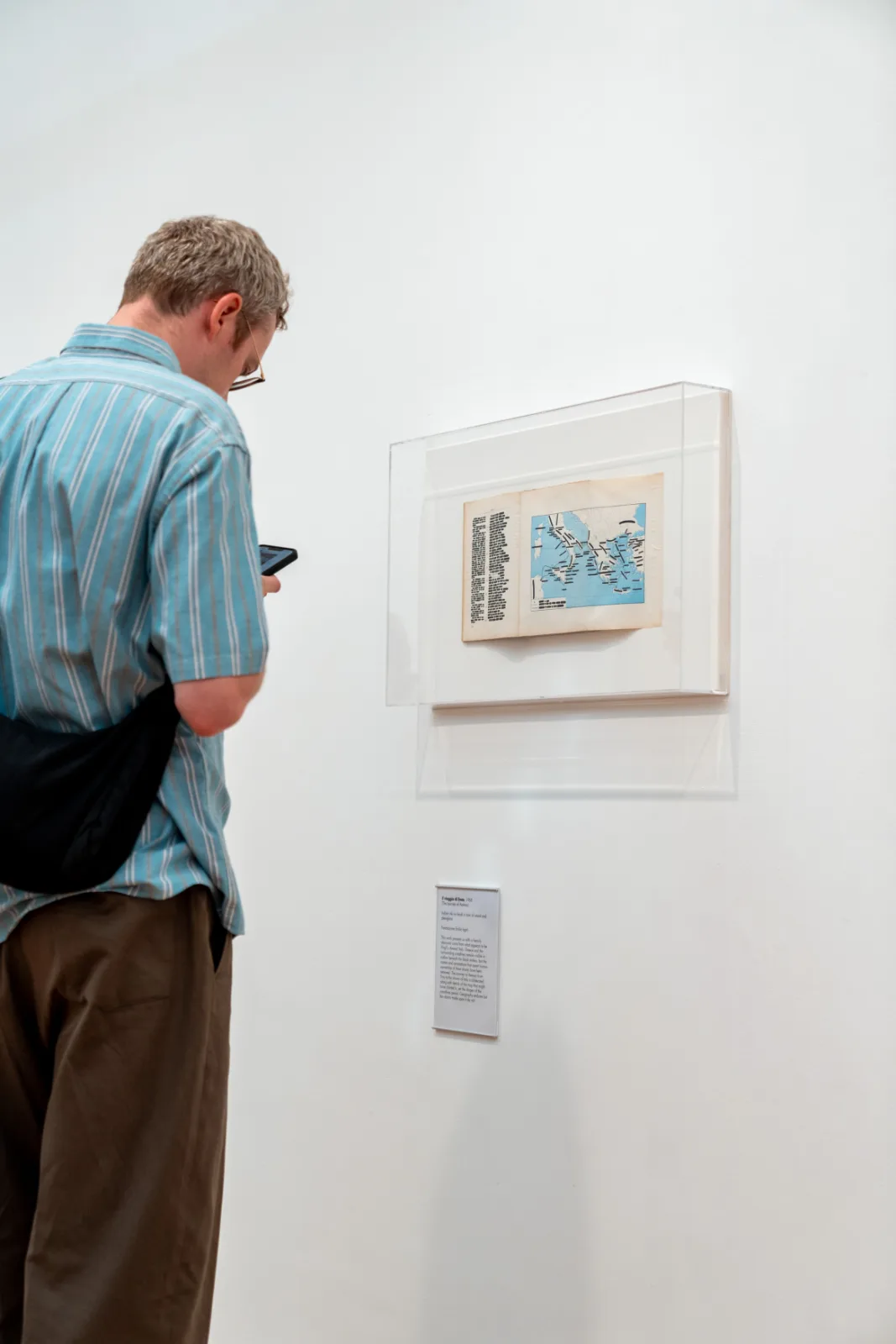
In 1968 the gesture leaves the printed page for the printed world. Il viaggio di Enea is an open book in a case. On the left, a numbered canto from an Italian verse translation of the Aeneid, heavily obscured, with a single surviving fragment: a phrase about black blood.
On the right-hand page there is a folded map of the Mediterranean. Italy, Greece and the Aegean keep their outlines beneath the strokes. Every name has gone. Cremoncini fixes the point in a sentence that holds for the whole room: "Geography endures but the claims made upon it do not."
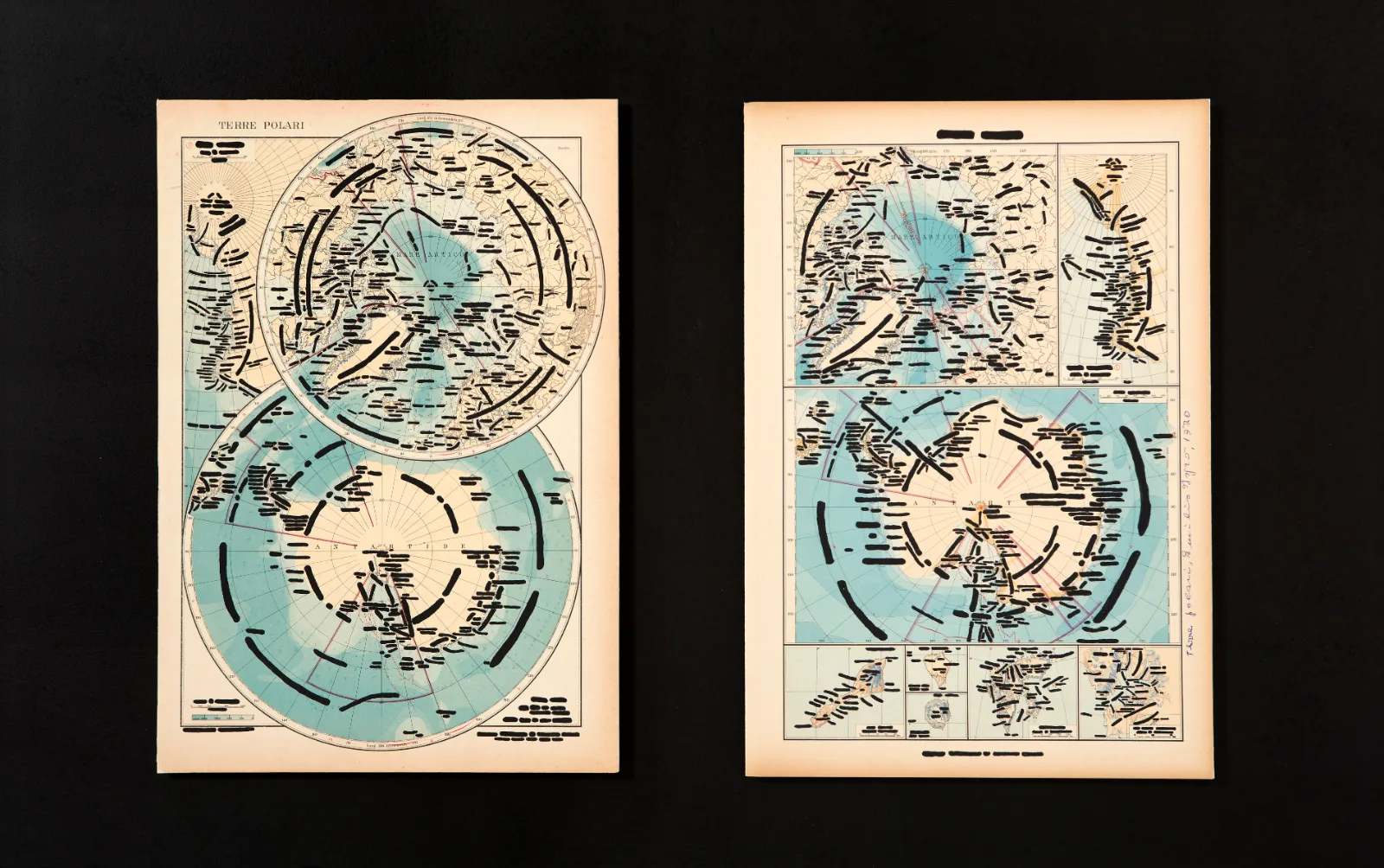
Storia inglese follows in 1969, a spread from a late Victorian atlas of Britain and Ireland in ochres and greens, its place names taken out by short vertical strokes falling across the landscape like rain. Then, in 1970, three works on geographical charts in a single year: Mar d'Irlanda, Mediterraneo, Terre polari.
What is left of a place when you erase its name
It is worth pausing on what a map materially is.
It is not simply the drawing of a coastline. It is that drawing plus the names somebody has written over it: place names, routes, legends, borders. And names do not describe, they assign. To say that a line separates two states is to declare that somebody measured, divided and claimed. Isgrò leaves the first part intact and erases the second. The coasts stay where they are; the act of appropriation deposited on top of them disappears.
Looking only at what survived, a regularity emerges across this group. Mar d'Irlanda keeps a single name, at the centre, in the water between the two islands: everything else, Britain, Ireland, the inset panels for Dublin, London, the Shetlands, is covered. Terre polari keeps three, and they are the title of the sheet, the Arctic Sea, Antarctica. Storia inglese and Il viaggio di Enea, whose maps show land that states have divided and administered, keep no place name at all.
Where the map shows owned ground, no name is left standing. Where it shows water, or the two ends of the planet no flag has truly managed to hold, a name is allowed to remain. What survives the ink are the places that belong to nobody.
"A world that erases"
A corridor runs between the two rooms, and on its wall a text signed by Isgrò. It sets out the misunderstanding the work has attracted for sixty years and disposes of it in eleven words:
"I have never erased: I have represented a world that erases."
Isgrò came to visual art from poetry and journalism, and has described himself as not born a painter but a poet, in a remark the catalogue reproduces from the Treccani volume edited by Germano Celant in 2019. On the curator's account, the Cancellatura was born of a crisis about how much the literary word could still carry inside a culture that had become overwhelmingly visual: a poet's crisis, not a painter's.
The faces
A second thread runs parallel to the maps, and it concerns faces.
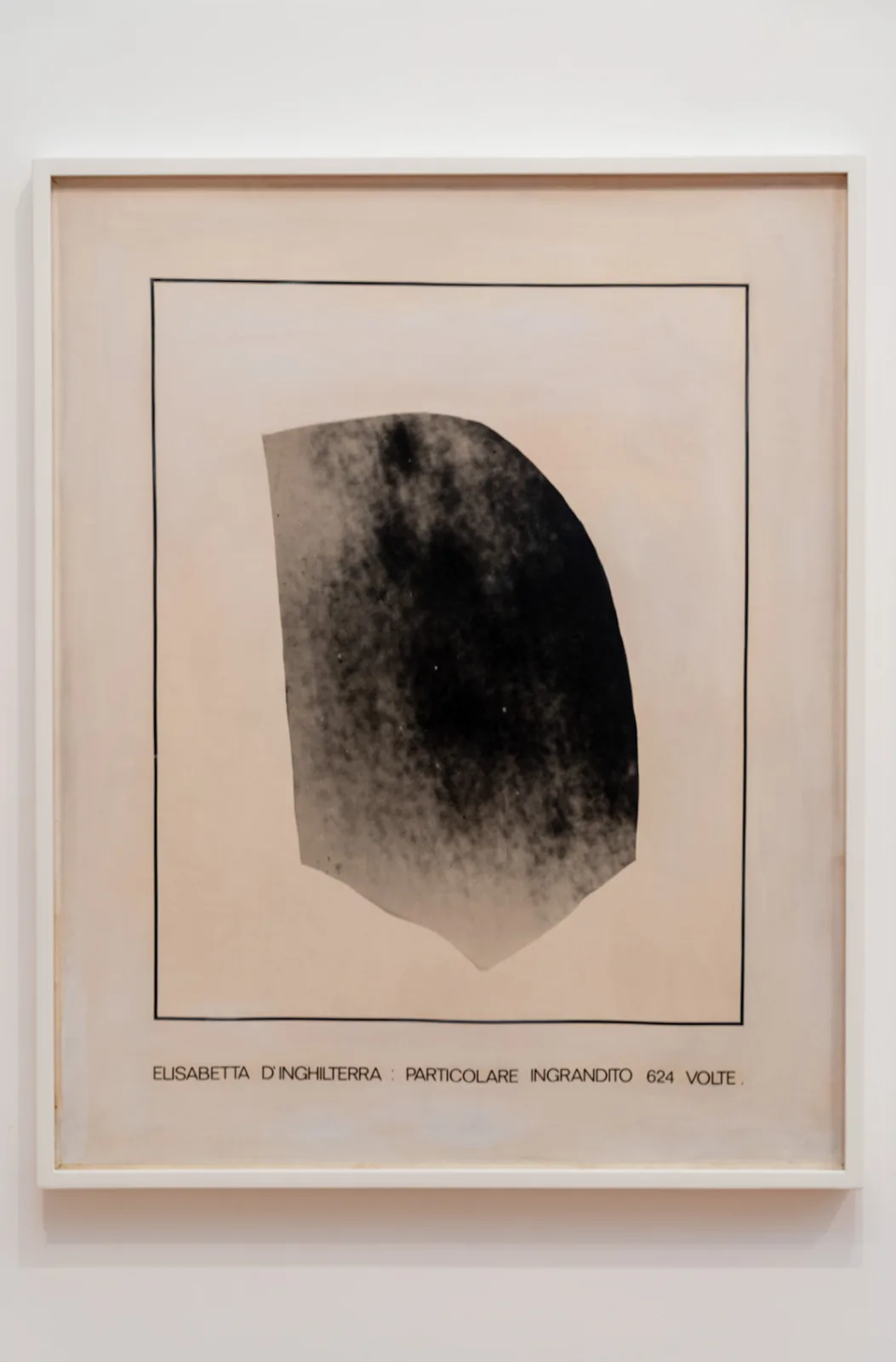
Elisabetta d'Inghilterra: particolare ingrandito 624 volte (1972) uses no ink. In every other work Isgrò covers: he lays black over the text and what lies beneath stops being visible. Here he does the opposite, he moves closer. He takes a detail of the Queen's official portrait and enlarges it to a point where the photograph no longer holds: the print breaks up into grain, a dark mass and a blurred edge remain, and the face is gone. The result is identical to an erasure, the image is illegible, but it has been arrived at by approaching rather than by covering. And the only thing declaring that a queen was ever there is the caption written beneath.
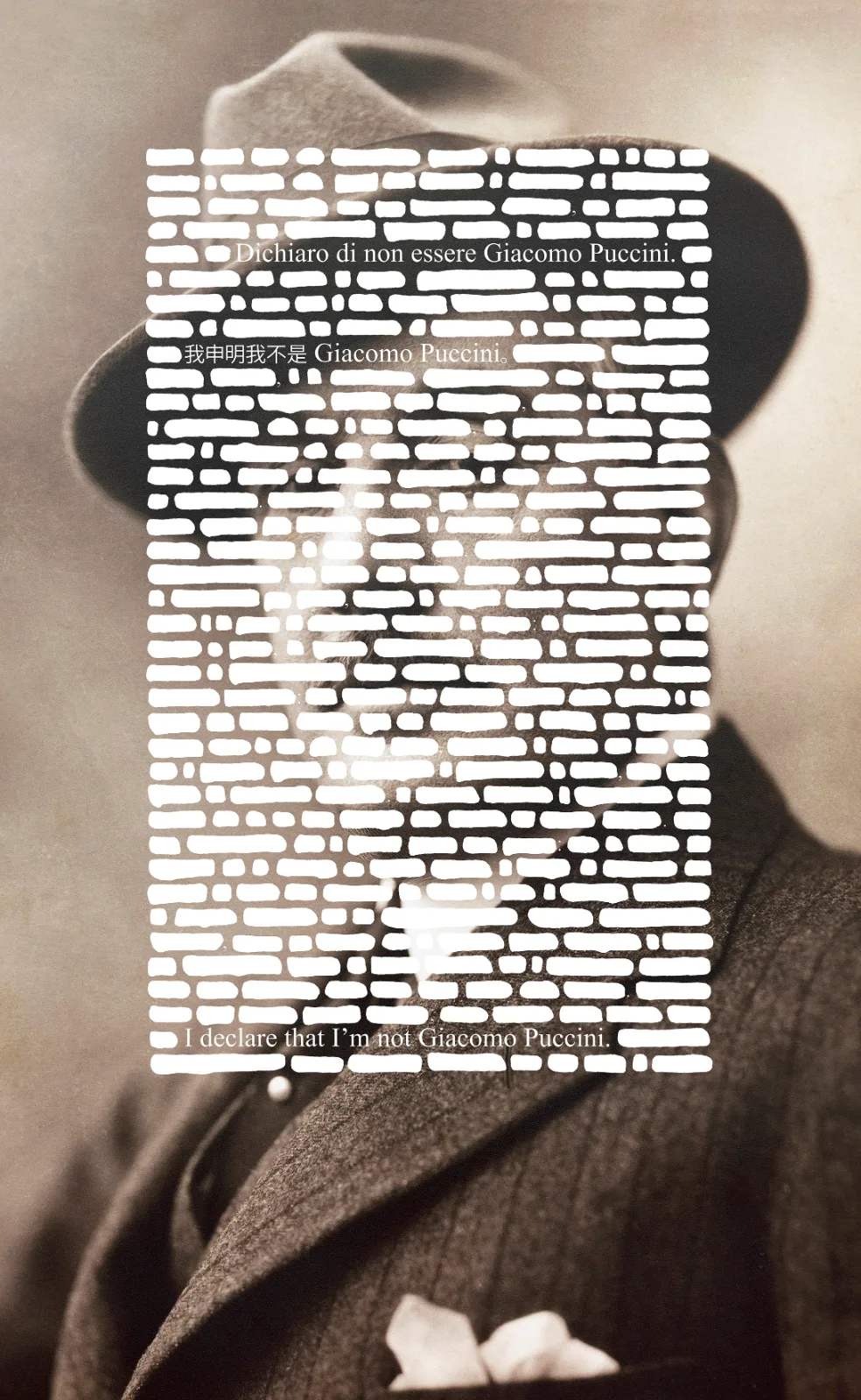
Forty-two years later, in Giacomo Puccini (2014), the same operation returns inverted. The composer's face is covered by white strokes rather than black, dense as a grid, and what survives are three lines in Italian, Chinese and English repeating the same declaration: dichiaro di non essere Giacomo Puccini, I declare that I'm not Giacomo Puccini. In her catalogue essay Cremoncini connects the trilingual declaration to Turandot, Puccini's last, unfinished opera, set in China and built around riddles and questions of identity.
Two portraits, forty years apart, the same mechanism as the maps: the face is the geography, and the name is the claim. Except that here the name stays, and serves to declare an absence.
The manifesto and the house that holds it
Manifesto del Futurismo and Manifeste du Futurisme (2012) are two sheets shown side by side, the Italian and the French version of the same text, erased down to a handful of standing words and, in the middle of the black, the line declaring where and when that text was published. On the Italian sheet the line survives whole: the Figaro of Paris, 20 February 1909. On the French one the name of the newspaper is covered and only the date remains. The masthead loses its name; the day does not.
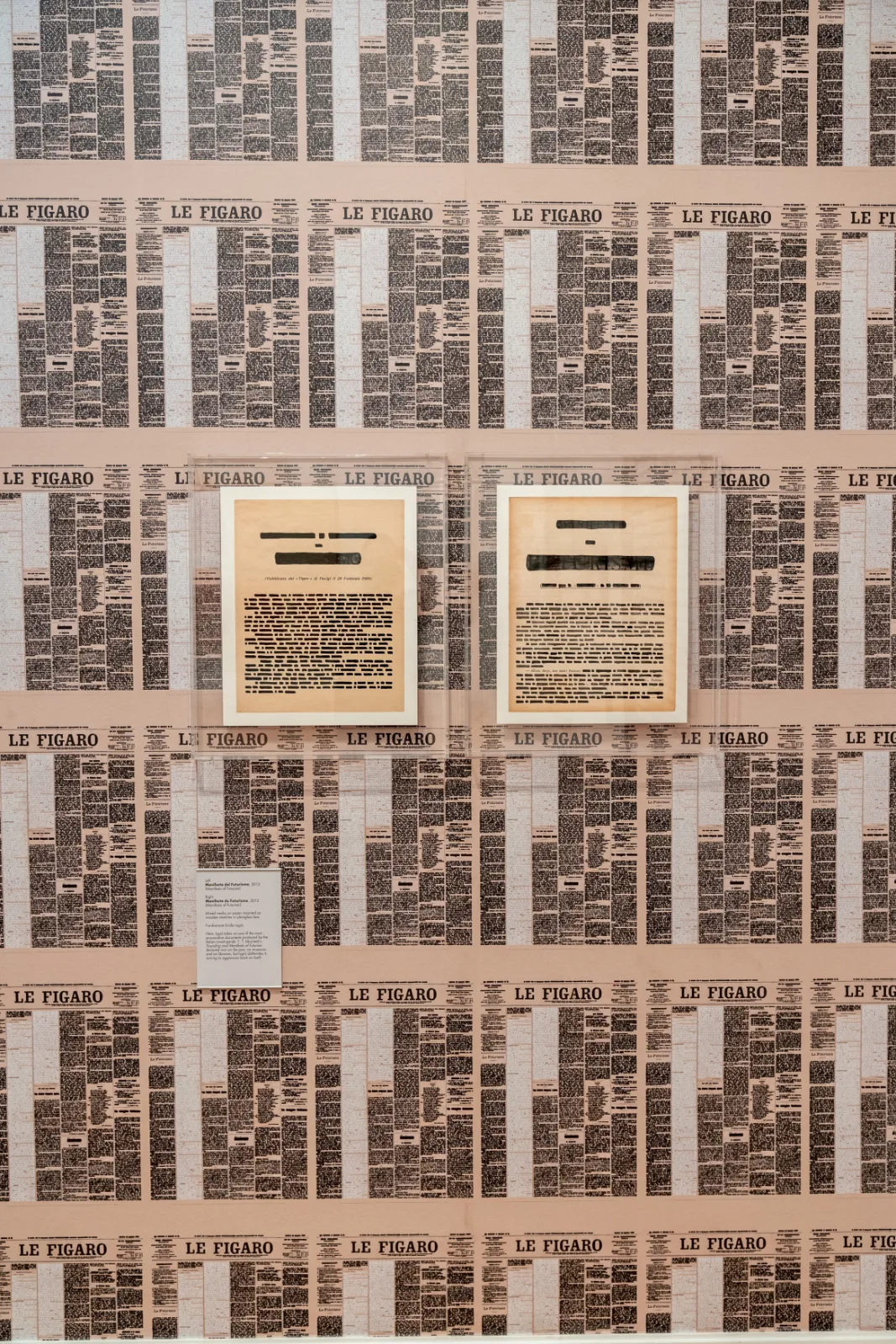
Cremoncini reads the gesture as turning the aggression of the text back on itself: Marinetti had declared war on the past, on museums and on libraries, and Isgrò obliterates him. She places the Cancellatura within a longer history of the page understood as a visual field, running through Marinetti's parole in libertà and the collage language of Dada, a tradition Isgrò inherits and radicalises.
But there is something that happens only in this building. The Estorick is the only British museum devoted to modern Italian art, and it is known above all for its Futurist core: Boccioni's Modern Idol, Carrà's Leaving the Theatre, Russolo's Music, Severini's The Boulevard, Balla's The Hand of the Violinist all belong to this house.
Which means that the founding manifesto of Futurism, covered in ink, hangs under the same roof as the paintings made by the men who answered it. The cancelled cause and its effects, one flight of stairs apart. And what the ink spares is the date on which it all began. In any other venue these two sheets would be a work about Marinetti; here they are a work about the collection that holds them.
The same question, new materials
The maps do not stop in 1970. They change substance.
Costituzione delle api (2010) is a map made of bodies. The Italian peninsula, Sicily, Sardinia, the eastern Adriatic and the Aegean are drawn on a bare ground entirely by swarming bees, with no coastline beneath them and no borders between them. And at the lower centre, in the position a chart reserves for its legend, sits a small block of black cancellations. On a map with no names to lose, the only thing struck through is the caption that would have explained it.
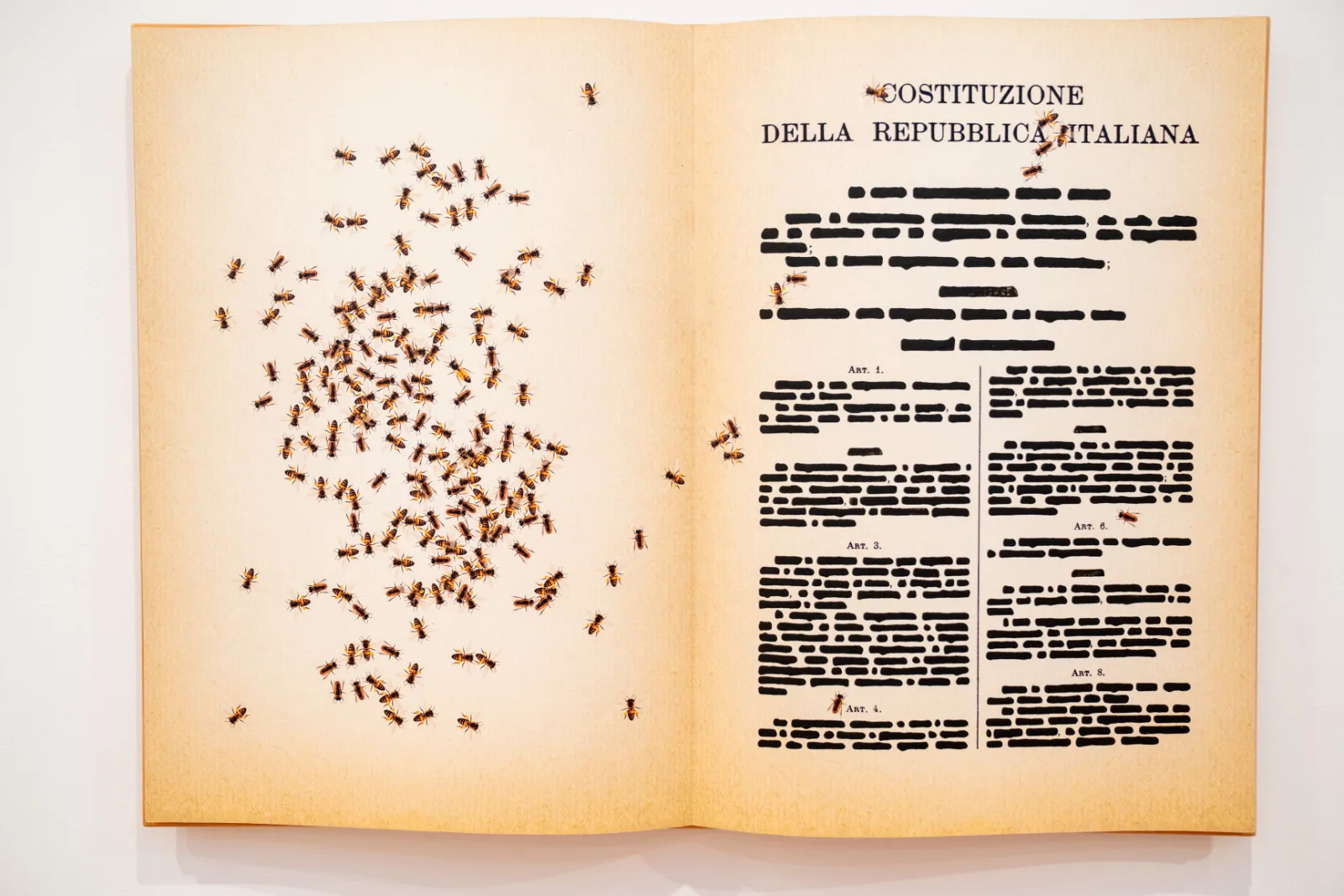
Its companion work of the same year, Fondata sul lavoro, applies the insects to text rather than territory: the opening article of the Italian Constitution repeated in overlapping rows, with ants massing at the centre. Cremoncini's reading holds the two possibilities together, and the constitutional promise stays suspended between them: the swarm obscures that text and at the same time enacts the labour the text claims to be founded on.
Then the globes. Where is Moscow? and Where is Rio de Janeiro? (2016) and Where is London? (2024) each pose the question in the title and paint over the answer. A globe is the one map that cannot be flattened, and the strokes have to follow the curve: on the blue sphere they gather across the oceans in elongated irregular rows, like sandbanks or shoals photographed from above, and on the black one they run red along the meridians.
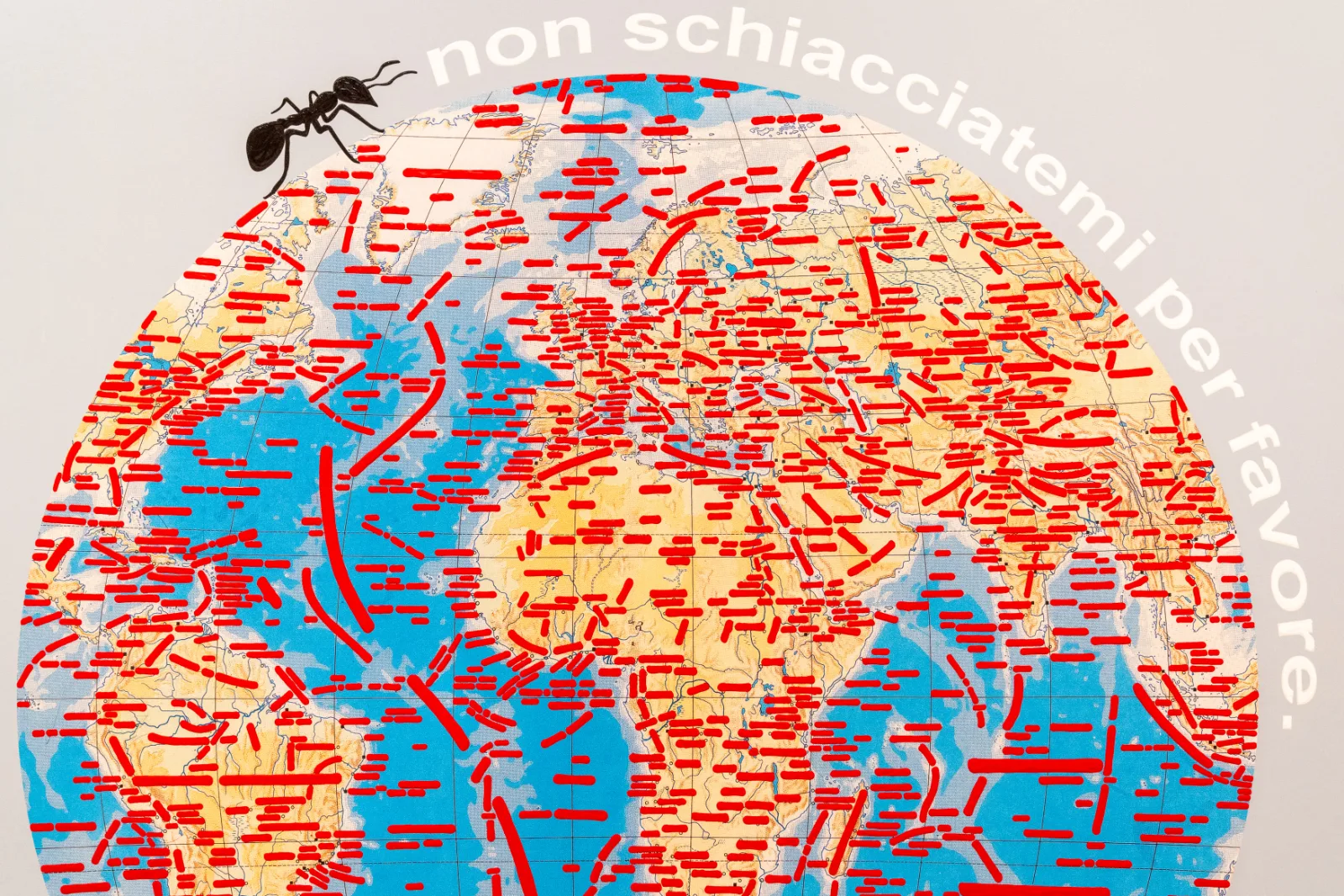
Non schiacciatemi per favore (2024) opens the same operation out to the whole earth: every continent and every ocean covered in red strokes, with a single black ant resting on the rim of the globe and the sentence curving around it. The smallest of creatures addresses the entire world, and asks only not to be crushed.
And there is one case in which the same gesture produces the opposite effect. In De vulgari eloquentia (2021), Dante's Latin treatise on the vernacular tongue erased in a thick, material red, what survives is almost nothing but place names: the tongue of the Sicilians, the most beautiful vernacular found in Italy, the royal seat that was Sicily. On the charts the place names were the first thing to go; here they are the only thing that stays. On an atlas the name is the claim, and removing it cancels the claim. In a treatise on language the name is the evidence, and leaving it standing leaves the argument.
The prayer and the letter
Two works, ten years apart.
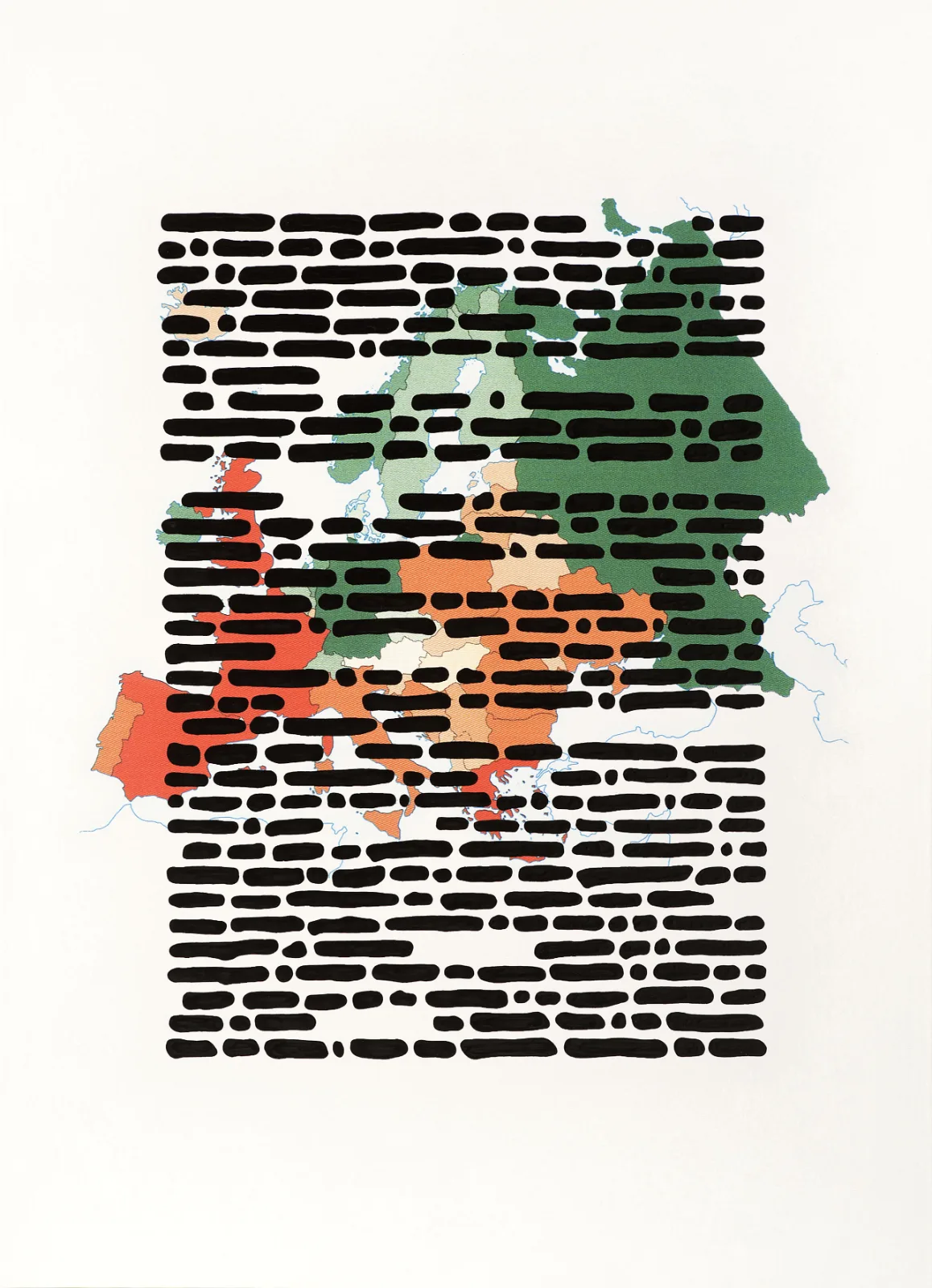
Preghiera per l'Europa (2016) returns to the cartographic motif after forty years. A large canvas presents a colour-coded political map of Europe: the deep greens of Russia and Scandinavia, the oranges and reds of the South and East, rivers tracing their blue across the frontiers. Over it, dense horizontal black strokes largely cover the national divisions beneath. Cremoncini reads it as a lament and a prayer at once, made in the year of the British referendum, for a continent whose political geography was about to be redrawn. Where Storia inglese had the cool, almost ironic detachment of the 1960s avant-garde, this is openly elegiac, and the title concedes that prayer may be all that is left.
Brexit (2026) was made for this exhibition. It is the letter of 29 March 2017 with which the United Kingdom formally opened its departure from the European Union, in twenty-seven sheets, one for each remaining member state, erased in black ink and in twenty-two carat gold. Gold, in the iconographic tradition of Western art, is the colour of the sacred and of what endures: to cover in gold is not to deny but to keep. Beneath that gold the same words resurface sheet after sheet, with the European Union, with the EU, with the European Union, until the phrase has been repeated by what survives more often than it ever was in the original document. For Isgrò, Cremoncini writes, Brexit is not a political position but a cultural wound, and the work carries a hope for Britain's return to a united Europe, if not necessarily to a Union.
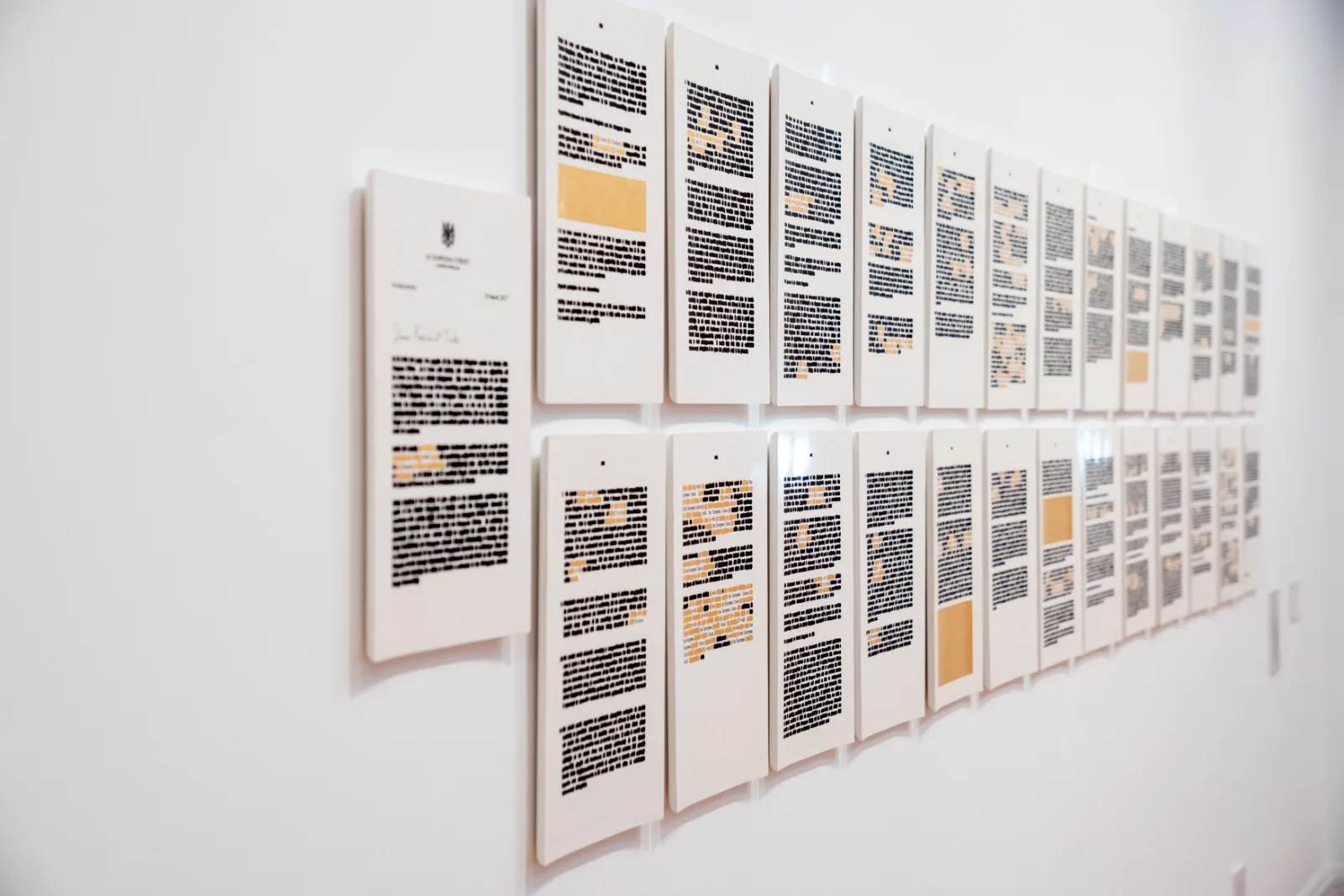
Seven works, sixty-one years: the British line in the exhibition
A British line runs through this exhibition, and it is easier to see from the far end.
It opens in 1965 with The Larch Fairy, an English children's book, its right-hand page filled by a solid black rectangle: the most complete deletion in the first room. It continues through the Victorian atlas of Storia inglese (1969) and the sea between the islands in Mar d'Irlanda (1970). In 1972 it becomes the portrait of the Queen dissolving into grain. In 1973 it becomes a tall column of police telex, Scotland Yard. In 2024 it becomes a globe with a question on its label: Where is London?
And in 2026 it becomes Brexit.
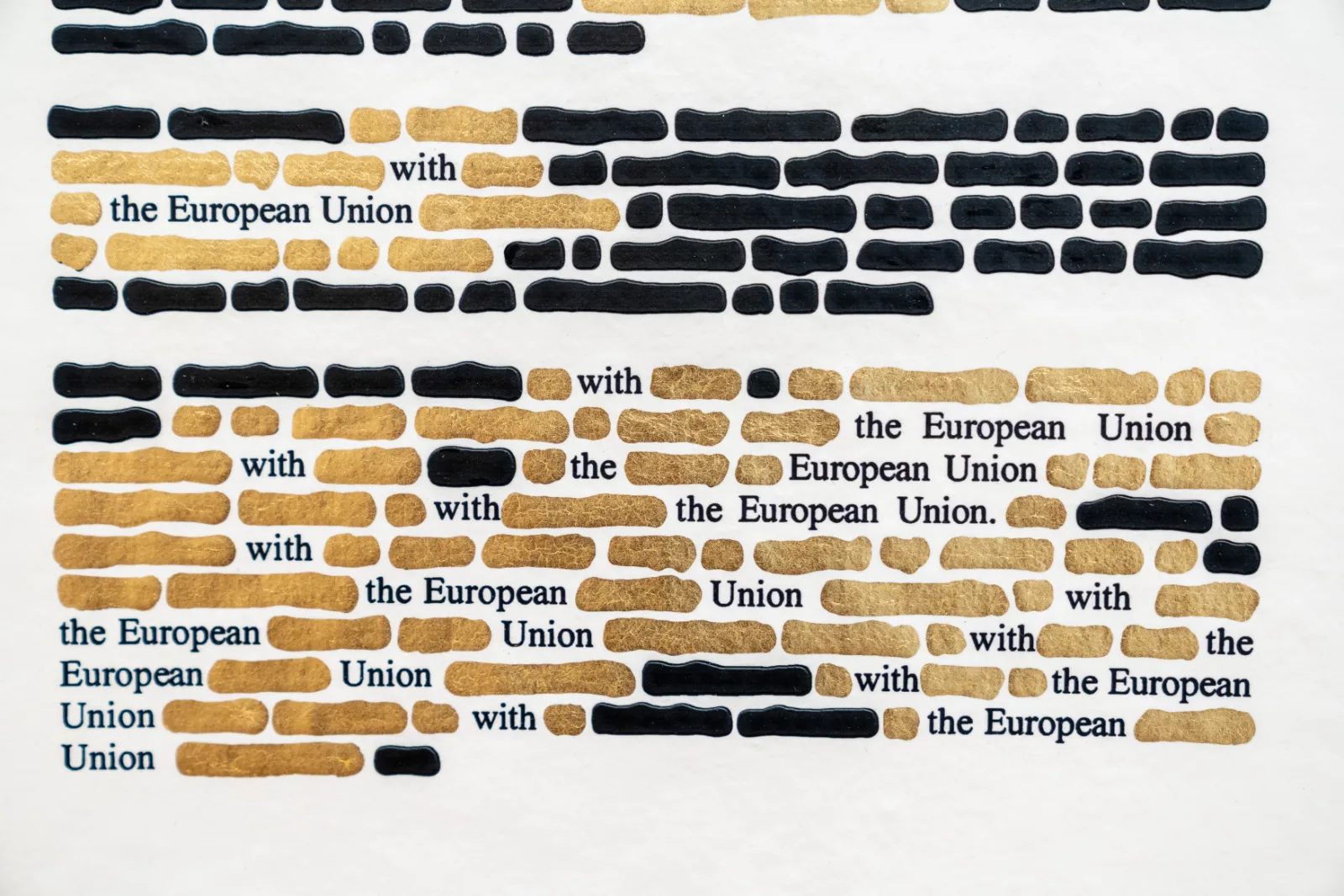
A children's book, an atlas, a sea, a state portrait, a dispatch, a globe, a diplomatic letter. The first British exhibition of this artist arrives after sixty years in which Britain has never stopped appearing in his work.
Back to the canto
Which returns us to the open book of 1968, and to what Aeneas finds at Buthrotum.
He comes ashore in Epirus and discovers that the Trojan survivors have rebuilt their city in miniature: a small Pergamum, a Scaean gate, a dry watercourse they have named Xanthus. The names have all been carried over. Not one of them brings anything back. The river is a dry bed with a famous name on it, and Aeneas embraces a threshold that is a copy of a threshold.
On the right-hand page of Isgrò's book the Mediterranean keeps its coasts and loses its names. On the left, the poem that gave those shores their story has been struck through, with one phrase left breathing. The book he chose to cancel is the book of Mediterranean wandering, of wrong landfalls and misread oracles, the book in which names come loose from places. And he cancelled it in the year he first laid ink on a map.
What is left on these pages was not left by accident. It was left by a reader who has spent sixty years deciding, line by line, what was worth keeping.
Read our editorial manifesto: A House for Stories
Related reading: Nothing You Can Point At — an island that four powers named and claimed, and that refused to be measured. A Dialogue from the ICA.
Watch curated films on AnotherStory Film Artists' films, portraits and visual trajectories between Italy and the United Kingdom.