Stare. It is the way to educate your eye, and more. Stare, pry, listen, eavesdrop. Die knowing something. You are not here long.
The Stage
The city has been so much more than a backdrop. "It's been a muse," says Alexander Moore, standing in the first room of the exhibition he has curated at Dulwich Picture Gallery. "It's been the stage on which so many significant events play out." Around him, more than a hundred photographs line the walls of a gallery founded in 1811, before any of these images existed, before photography itself existed. Dulwich was Britain's first purpose-built public art gallery, and it was made for paintings. This is only the second major photography exhibition in its history, after Unearthed: Photography's Roots in 2021. Its Director, Jennifer Scott, frames that encounter as a continuity rather than a rupture: the show, she has said, "creates exciting visual links to the landscape paintings in our Collection." Now the walls also hold a century of American light.
Portrait of a City: A Century of American Photography gathers work made between 1907 and 2012 by thirty-eight photographers, all of it drawn from a single source: the Savings Bank Foundation DNB collection in Norway. The photographs are American. The collection is Norwegian. The curator works between London and Scotland. The gallery is in south London. And the exhibition, which runs until 4 October 2026, does something that none of its individual elements could do alone: it tells the story of how photography learned to see the American city, and how the American city, in return, taught photography how to look.
How Photography Learned to See
The story begins with Alfred Stieglitz aboard a transatlantic steamship in 1907. Looking down from an upper deck towards the steerage passengers below, he sees something that crystallises years of restless thinking about what photography can do. A round straw hat. A gangway cutting diagonally across the frame. White suspenders on a man's back. Shapes relating to one another. He has one unexposed plate. He releases the shutter. The image he makes, The Steerage, is not a document of poverty or migration, though it contains both. It is the moment Stieglitz realises that photography does not need to borrow the language of painting to think seriously about the world. The medium has its own grammar, and that grammar is made of structure, light, and the fraction of a second in which everything aligns.
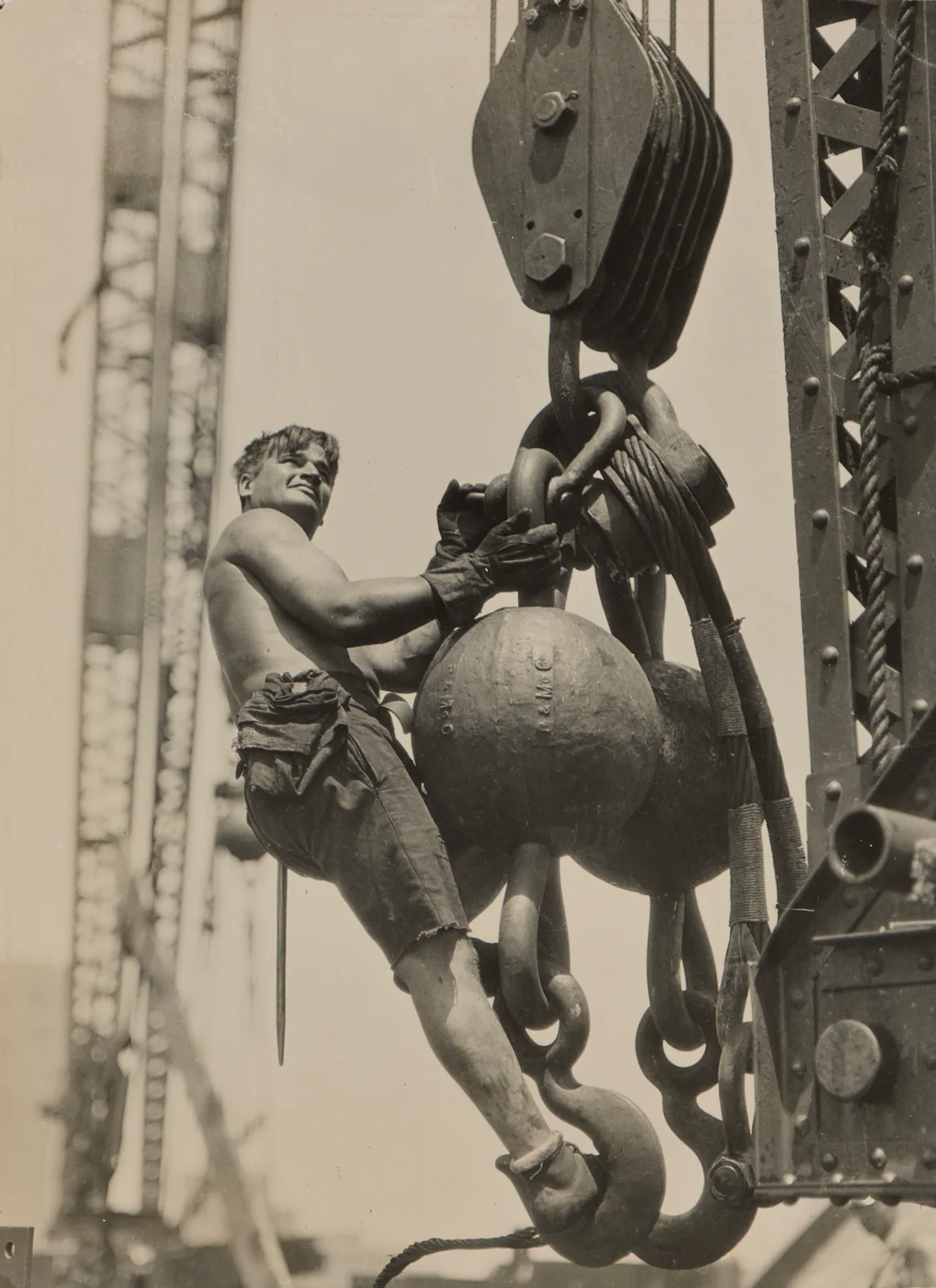
From here, Moore's exhibition traces a path that is not chronological in the usual sense. It follows the evolution of a gaze. In the early rooms, that gaze is still forming: Lewis Hine climbs the steel skeleton of the Empire State Building in 1930, strapping himself to beams alongside the ironworkers, and photographs Victor "Frenchy" Gosselin riding a steel ball some eight hundred feet above the ground without a harness. Gosselin was a French-Canadian immigrant, one of a largely migrant workforce doing skilled work at extreme heights with almost no protection. Migration is already inside the frame, long before the pictures themselves begin to travel. The worker appears composed, almost relaxed. The white void behind him, the absence of any other building on the horizon, is what tells you he is on top of the highest structure in the city. Hine shares the worker's vantage point. There is no safe distance.
Then the gaze sharpens. Dorothea Lange stands outside the White Angel Jungle, an informal relief settlement on San Francisco's waterfront during the Great Depression, and isolates a single figure in the crowd: a man in the foreground, arms crossed, hat pulled low over his eyes, his back turned to the crowd behind him. The others dissolve into soft focus. The photograph is White Angel Breadline, San Francisco, 1933. Moore, speaking of Lange during the press view, says something that stays: "Photography doesn't record history. It organizes it." Lange's image does not show the full scene. In the catalogue he has written with Nils Ohlsen, Director of the Lillehammer Art Museum, Moore points out that other photographs of the White Angel Jungle reveal a bustling, decorated, almost joyous space, with its founder Lois Jordan serving food with performative flair. Lange excludes all of this. By isolating the man in the crowd, she tells us less about the place but produces an image capable of standing in for the Great Depression as a whole. The power of the photograph comes not from what it shows but from what it leaves out.
The Street as a Stage
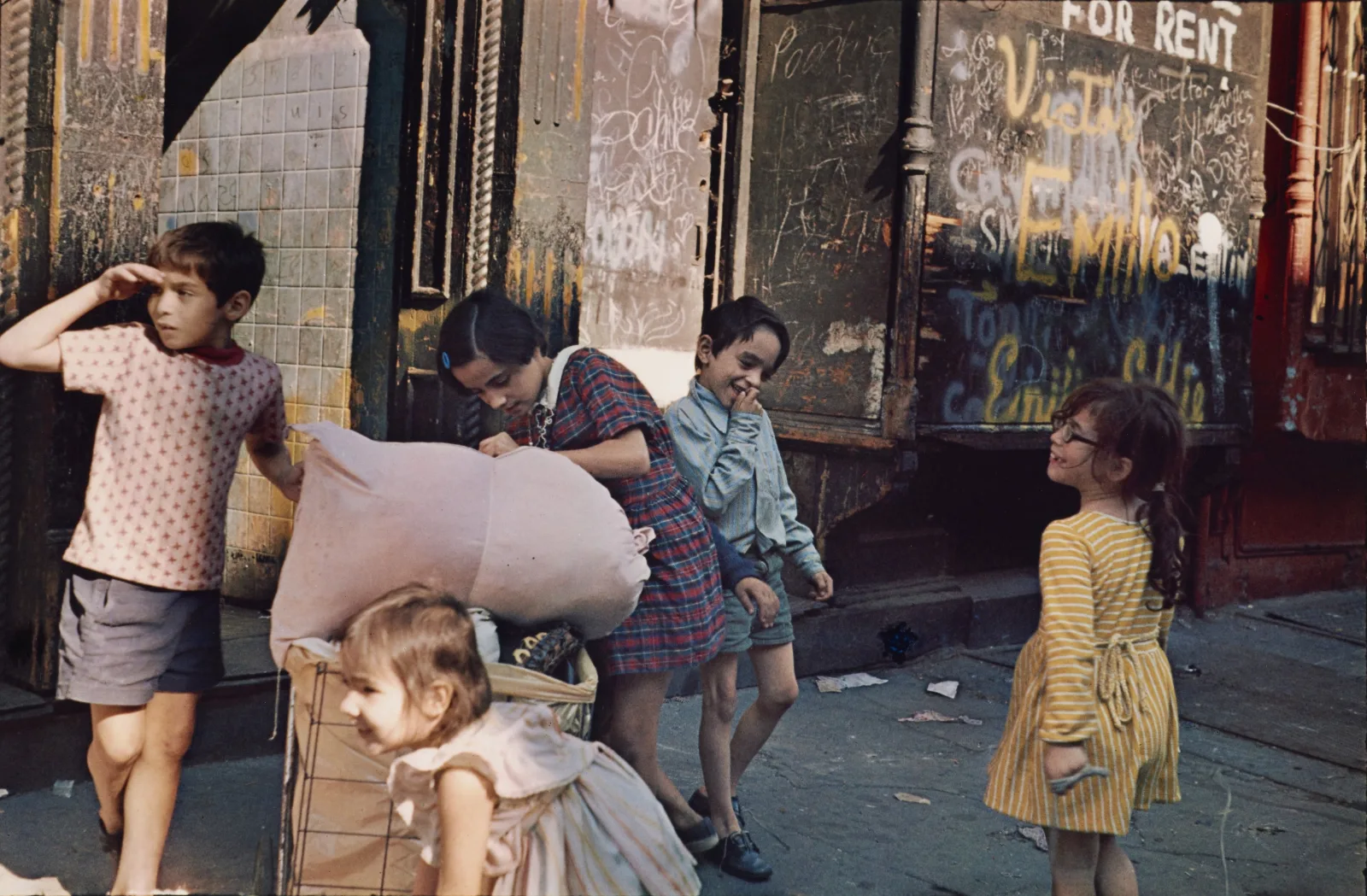
The exhibition moves from the Depression into New York's streets, and the gaze changes again. Helen Levitt walks through Harlem and the Lower East Side with a small camera, photographing pavements, children playing, improvised performances. Roy DeCarava, who lives in Harlem, photographs the same neighbourhood from the inside: dancers emerging from shadow in a Harlem dance hall, barely visible, the image so dark it requires the viewer to look slowly, to adjust. Moore describes the complexity: "He thought about the gestures, the complexity of Black Americans being forced to find new forms to survive. But creativity is reflected in Black life and the Black experience in America."
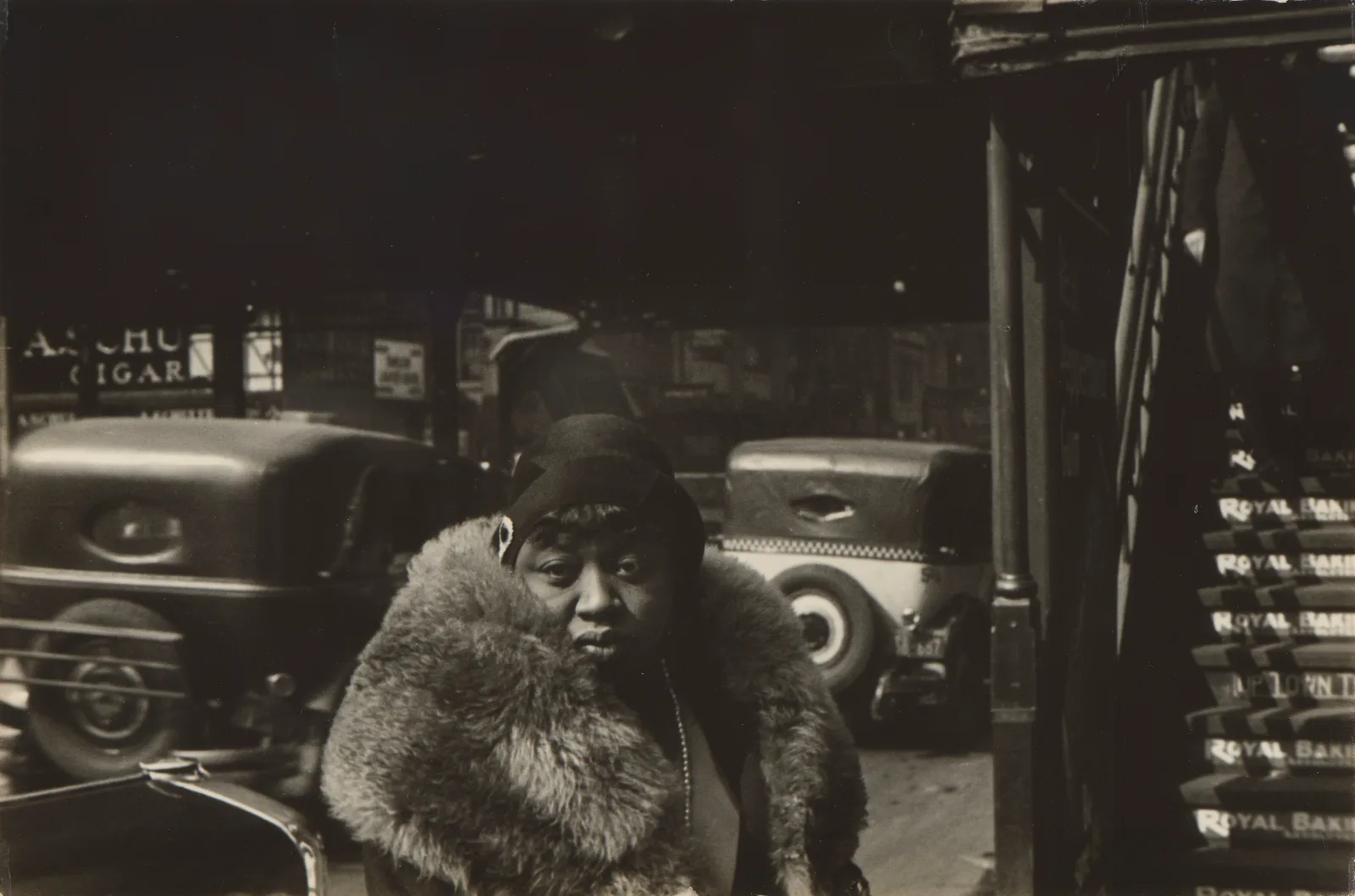
Walker Evans, whose words open this piece, is in these rooms too. 42nd Street and Sixth Avenue, New York, 1929: a woman in a heavy fur collar under the elevated tracks, caught between parked cars and shop signs, looking somewhere past the camera and not at all pleased to be seen. Evans spent his career arguing that photographs gain their force not from the single emblematic image but from relation, from sequence and juxtaposition, and he made the argument in book form with American Photographs.
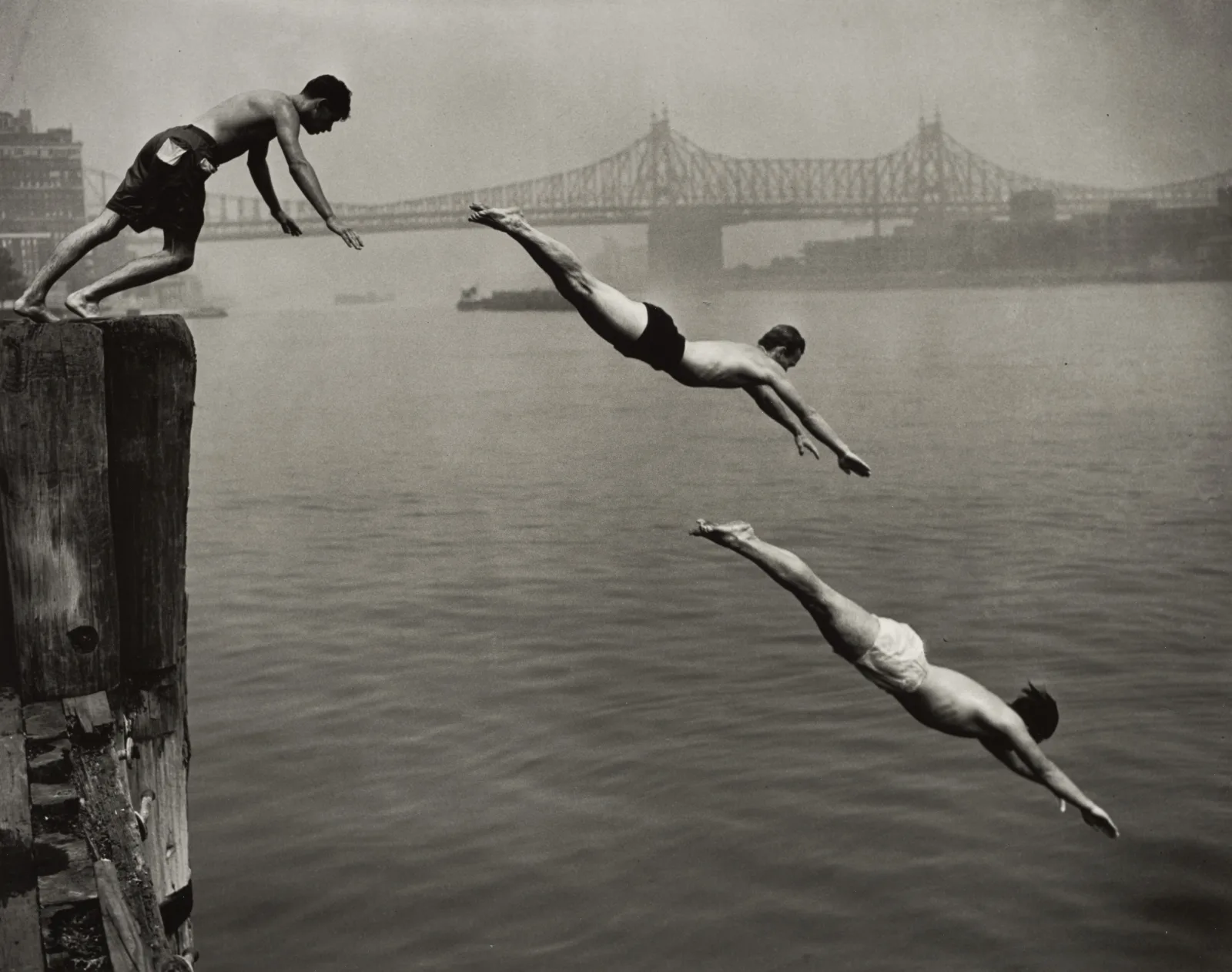
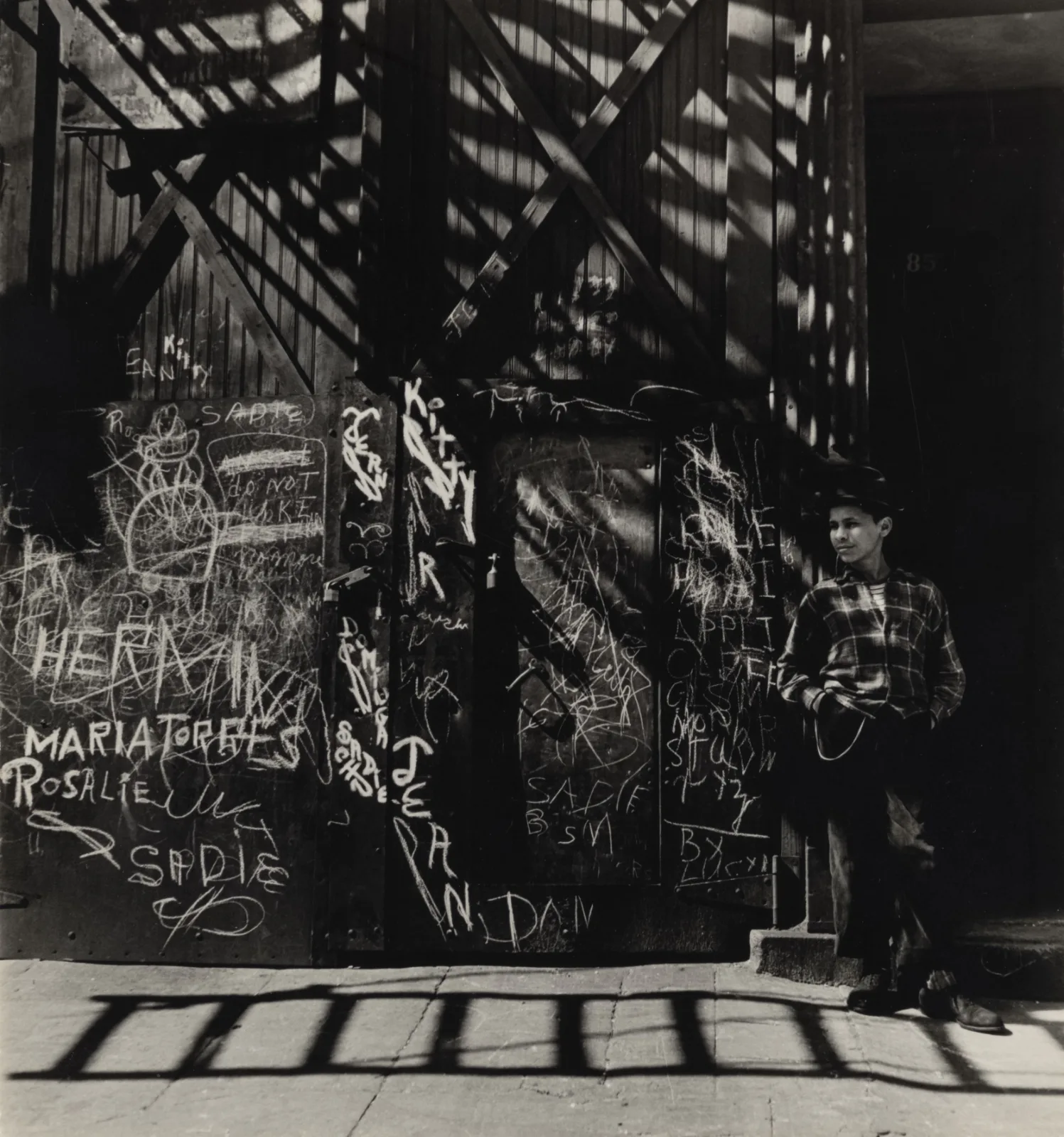
Several of the photographers in these rooms belonged to the same organisation, though it was never quite a school. The Photo League gathered photographers committed to documenting the city and the conditions people lived in, and its members surface throughout the exhibition. Arthur Leipzig was one of them. Born in Brooklyn in 1918, he arrived at photography by accident, after badly injuring his right hand working at a glass wholesaler, and took it up as a way of earning a living. His Divers, East River, 1948, shows boys throwing themselves off a river wall on the Manhattan waterfront. Behind them stands the Queensboro Bridge, and beyond it Roosevelt Island, known then as Welfare Island and given over almost entirely to hospitals, asylums and municipal institutions. Three bodies in mid-air, suspended between the water and the infrastructure of a city that had already decided what that stretch of the river was for. The boys had decided otherwise. Rebecca Lepkoff, another League member, photographed the Lower East Side in the same years: a boy standing against a boarded doorway covered edge to edge in chalked names, the shadow of a fire escape falling across the pavement like a grid.
Looking back in 1995, Leipzig was unsentimental about those years. The streets had been poorer, more violent, more corrupt than nostalgia allows. What had been different, he wrote, was that "we believed in the possible."
The League did not survive the decade that followed. In the early 1950s its members came under FBI scrutiny and the group was designated a subversive organisation. Lisette Model, who had left Vienna for the United States in 1938, lost commercial opportunities and turned increasingly to teaching. At the New School for Social Research, and in private classes at her own home, she shaped a generation of photographers. One of her students was Diane Arbus.
Then Weegee, born Arthur Fellig in what is now Ukraine, who grows up in extreme poverty on the Lower East Side, sleeps rough, fails at street photography, and eventually takes an apartment across from Manhattan Police Headquarters. He installs a police radio in his car and spends years chasing crime scenes through the night. His photographs are blunt, flash-lit, unsentimental. Moore notes the self-invention: "He created the monster and he couldn't get rid of it. He was afraid of what he'd found." Weegee later reinvented himself as "Weegee the Famous," stamping his prints, cultivating relationships with editors, reversing the direction of photographic desire: ascending from the city's underside instead of descending into it.
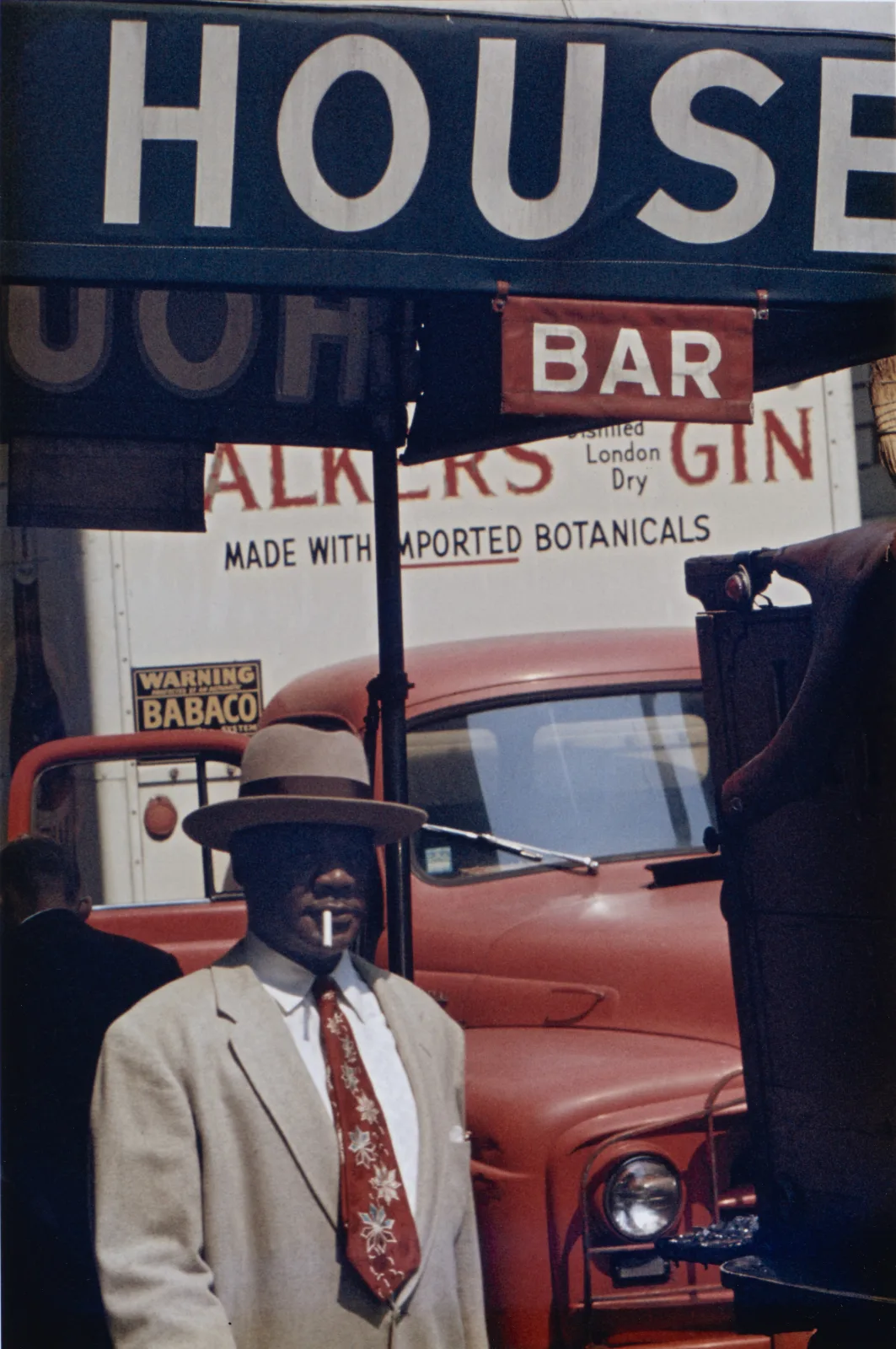
And then there is Saul Leiter, whose New York feels quiet and personal despite being one of the busiest cities on earth. Moore speaks of him with particular warmth. Leiter works in colour at a time when colour is not considered serious. He photographs from his apartment window, through rain, through reflections, through obstructions. His Harlem, 1960, is markedly busier than his usual work, as if the neighbourhood's density overwhelmed even his tendency to fragment and filter. A film about Leiter by the director Thomas Leach is among five films screened within the exhibition, showing the photographer at work in the final years of his life.
I've always loved colour. It seemed to me a perfectly normal, valid thing to do. There was for the longest time a prejudice against color in photography. But we live in a world of color. I never questioned its value.
New Documents: Arbus, Winogrand, Friedlander
In the rooms where Diane Arbus, Garry Winogrand and Lee Friedlander hang side by side, the exhibition reaches its most charged point. These three were shown together at the Museum of Modern Art in 1967, in an exhibition called New Documents, and Moore takes visible pleasure in reuniting them here. "I love the idea that we are standing in some kind of historic reunion between three such big names, all here in a line."
Arbus grew up in extraordinary wealth, isolated from the street life her photographs would later seek out. "A photograph is a secret about a secret," she wrote. "The more it tells you the less you know." Moore lingers on her images: a young girl in the back of a car, a teenage couple on a sidewalk, a woman with white gloves and a fancy hat. At first glance, ordinary. But the young girl seems imprisoned, almost frightened. The teenage couple looks young but disturbingly mature. The hat sits too deliberately. There is a story from Arbus's childhood: she heard there was a nudist settlement in Central Park and begged her governess to take her to see it. She was denied. Moore suggests that much of her career can be understood as an attempt to cross the boundaries she was otherwise prevented from crossing.
Winogrand is the photographer who wants to disappear. He describes the act of photographing as a state in which he is able to remove himself from conscious thought: "I get totally out of myself. It's the closest I come to not existing." Moore finds this endlessly fascinating: "Surely every photograph contains the photographer. Every decision about where to stand, when to press the shutter, what to leave out shapes the image." But Winogrand is not talking about technique. He is talking about a way of existing in the world. His Guggenheim application describes postwar America as a society based on illusions and fantasies. "We have lost ourselves," he writes. And then, at the end: "I must continue the photographic investigation further and deeper." Photography had become, for Winogrand, a way of keeping a grip on a reality he felt was dissolving.
Friedlander works with the surfaces that separate. Shop windows, car mirrors, shadows cast on the pavement: his photographs always contain more than one plane, more than one reality. In New York City, 1962, a woman sits on the windowsill of a laundromat, waiting for her washing, while the parked cars and façades from across the street arrive in the glass as reflection: two realities occupying one sheet of paper. In Chicago (Self-portrait), 1963, he photographs himself, or rather his shadow and his partial reflection, anticipating the strategy that would define his first book, Self Portrait, in 1970. Two of the works here are not city pictures at all: Atlantic City, 1971, and Banff, Canada, 1974, which extend the same method outside the American street. In his catalogue essay, Ohlsen sets the 1962 photograph beside Manet's Un bar aux Folies-Bergère, where a mirror performs the work a laundromat window performs here: holding two orders of reality on a single surface, eighty years and one medium apart. Where Arbus seeks the secret and Winogrand seeks to vanish, Friedlander multiplies: he is present in the image as shadow, as reflection, as a figure who cannot stay outside of what he photographs.
The Margins
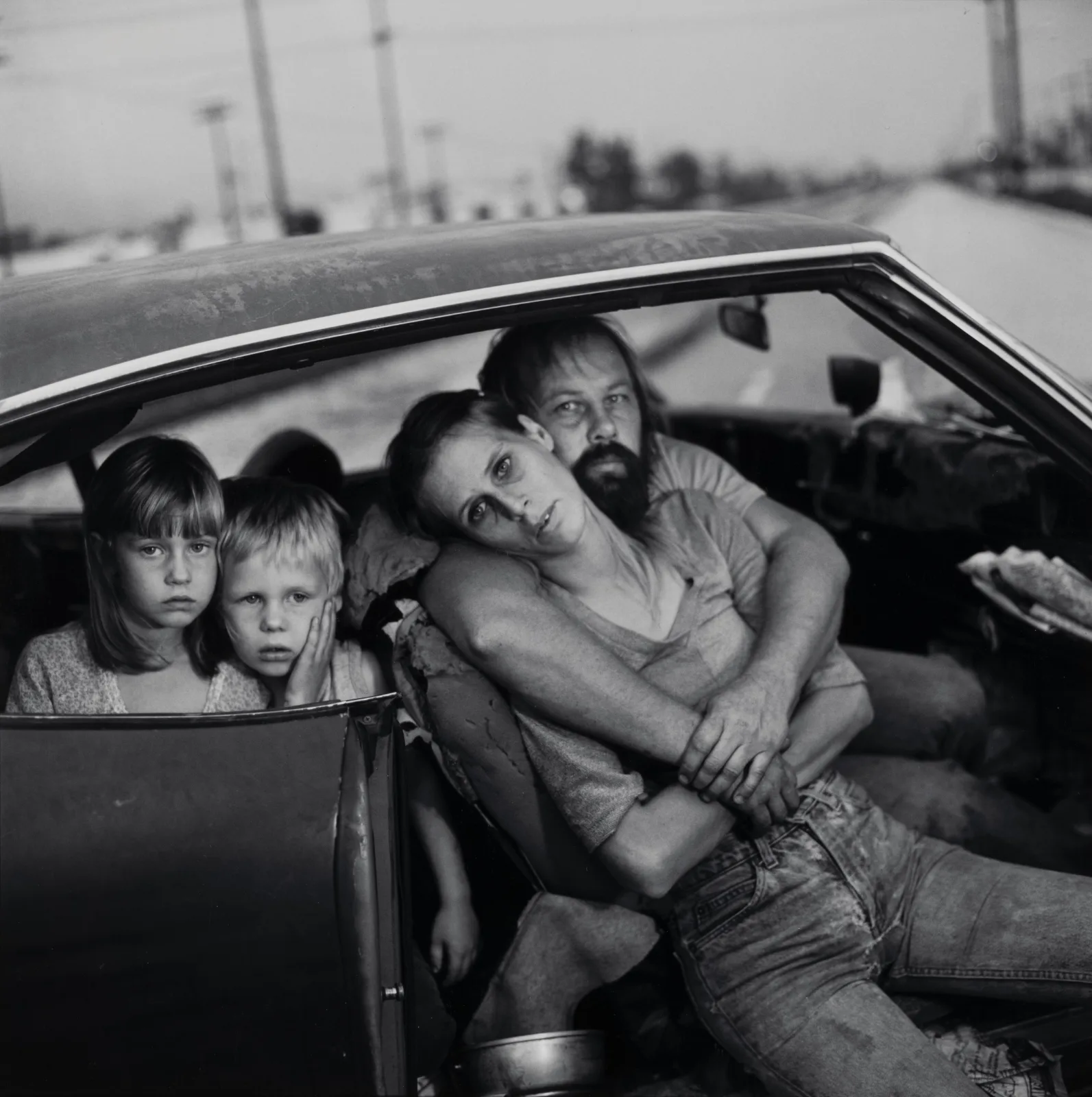
The rooms that follow move into the 1980s and towards the edges of the city. Mary Ellen Mark photographed the Damm family in 1987, living in their car outside Los Angeles: four people and everything they owned compressed into an interior with no room left over. Mark worked slowly, returning to her subjects over months and years, and told people plainly why she was photographing them and where the pictures would end up. The tightness of the frame is the argument. The family is never shown apart from the conditions it is living in, because there is nowhere else to put them. In the same section hangs Peter Hujar's Richie, 1985, made in the middle of the AIDS crisis, a portrait of the kind of intimacy that only becomes possible when there is very little time left.
Underground
The last rooms belong to Bruce Davidson's Subway pictures, made between 1980 and 1985. Davidson photographs the New York subway at a time when the system is associated with neglect, graffiti, and rising crime. He works with a flash, sometimes just a few feet from his subjects, catching them in moments of extraordinary psychological charge. Writing about the series in 1986, Davidson described wanting to turn what he called the system's "dark, degrading, and impersonal reality" into pictures that gave back colour and vitality to the people riding it every day. The subway was filthy and dangerous, and it was also the most democratic room in the city: millions of New Yorkers pressed together daily, with nowhere to look but at each other.
One image stops Moore mid-sentence during the press view. A young boy in a subway car, looking directly at the camera, trying to figure out whether he is being photographed or not. Outside the window, the Twin Towers catch the evening sun and seem to glow. "It's impossible now not to look at this building differently because of what happened," Moore says. "But this picture was taken twenty years before 9/11. At the time, the towers were simply part of the everyday landscape." The photograph has changed. Not the image itself, but what it means. The towers, once background, are now foreground. Time has reorganised the photograph, just as Lange reorganised the breadline.
This is what photographs do. They absorb a future they cannot know. The print stays fixed; everything that happens afterwards happens inside it anyway. What a photograph shows is settled at the moment of exposure. What it means is not.
The Journey of Images
Images migrate also, and in doing so, they change.
The photographs in this exhibition were taken in New York, Los Angeles, Chicago and San Francisco by American photographers. Then they began to travel. A Norwegian savings bank foundation assembled them over the past ten years, building a body of twentieth-century photography now held on permanent deposit at Lillehammer Art Museum and Drammens Museum. For Anders Bjørnsen, who runs art and culture at the foundation, what a collection like this proves is "photography's unique ability to tell human stories across time and place." Alexander Moore, Creative Producer at Dulwich Picture Gallery, brought the work to London and hung it in rooms built for paintings.
At every stage of this journey, the photographs have changed. Not physically: the prints are the same gelatin silver and dye-transfer surfaces they have always been. But the gaze that falls on them shifts with each new context. What a New Yorker sees in Helen Levitt's photograph of children on the Lower East Side is not what a visitor in Lillehammer sees, which is not what a visitor in Dulwich sees. The image remains. The meaning migrates.
Moore writes it in the exhibition catalogue, speaking of Dorothea Lange's Migrant Mother. The same photograph, printed at high contrast in Vietnam, made Florence Owens Thompson's skin appear dark. A soldier who owned it was convinced she was Black. The image had not been altered. The context had.
This exhibition is itself an act of migration. American images, Norwegian stewardship, a London gallery born for paintings. The photographs arrive here carrying the weight of a collective memory shaped by every eye that has looked at them, every wall they have hung on, every caption that has framed them. And they will leave carrying our gaze.
The traffic runs both ways. This is the third project Dulwich has made with the foundation, after two exhibitions of Norwegian painting, and in 2027 a group of works from the Gallery's own collection travels north to Lillehammer, for the museum's centenary and the town's two hundredth year. Migration is not an event that happens once, at the start of the story. Here it is the working method.
Photography's role has been to catch and reveal our stories. Against the overwhelm and scale and pace of the city.
Moore closes the press view standing in front of Davidson's subway pictures. The sentence sits in the room the way Lange's solitary figure sits in the breadline: quietly, without insisting, holding more than it says.
Above the pictures, in white letters on the grey wall, Davidson has the last word. He would rather photograph, he says, "in Grand Central Station than in the Grand Canyon." A gallery built for landscape paintings, hung for one summer with a century of cities. The images travelled a long way to make that argument here.
Credit: Portrait of a City: A Century of American Photography opens at Dulwich Picture Gallery 28 July – 4 October 2026. Presented in partnership with Savings Bank Foundation DNB and created in collaboration with Lillehammer Art Museum.
A House for Stories — the editorial manifesto of the Journal.
AnotherStory — curated films, portraits and visual trajectories.