A clear blue culler.
The Story Arrives as Speech
The story arrives first as speech. Giardina Papa heard it as a child in Sicily, from a grandmother who spoke Sicilian, never Italian, and who, as Giardina Papa puts it, "knew how to tell a story."
Everything that follows is built on that. She Flickered In and Out of History is the second work in a trilogy about forgotten and erased Mediterranean histories, made in the tradition of counter-history and oral culture. The first, U Scantu: A Disorderly Tale, premiered at the 59th Venice Biennale in 2022 and confronts the archives of the Spanish Inquisition in Sicily through the vernacular myth of the donne di fora, the women from outside. The audacity of the trilogy, as she puts it during the talk, is to assume these stories signify beyond Sicily.
But she is careful to separate the two things. The grandmother is where the story came from. The work is not a transposition of it. Each film rests on a year or more of archival research, and she is, by her own description, a slow artist: one project every two years.
Not Sicily. The Mediterranean
Erika Balsom opens by noticing a word. Giardina Papa calls this a trilogy of the Mediterranean, not a trilogy of Sicily. What is at stake, Balsom asks, in that move from land to water, from territory towards a different kind of aquatic imaginary?
The answer reverses the map. Learn the history of Sicily, Giardina Papa says, and you understand that the centre was never the land. It was the water. The sea was the road that joined the shores. For long periods it was easier to reach Tunisia by boat than to cross the mountains and volcanoes of Sicily to arrive on the other side of the island.
Against this she sets the rhetoric of the last two decades, which has taught Europe to hear the Mediterranean as a border, the thing that divides the continent from whatever lies beyond it. The trilogy is an attempt to undo that border, and Sicily is where the undoing is already visible: in the food, in the crossings, in the language.
Below the water the argument continues on another scale. Sicily sits above a subduction zone where the African and Eurasian plates are moving towards each other. In geological terms they are still travelling. Go deep enough and the border does not behave as a border at all.
Balsom presses the point, and it turns out to be the reason she asked. On the surface this is a work about something that happened in 1831. In fact that is not fundamentally what it is about. Giardina Papa agrees without hesitation. She has known the story since childhood, but she is telling it now because of the present: a Gulf of Mexico renamed in a day, designs on Greenland, Gaza, Ukraine. The logic of conquest is resurgent, and the story of a land that refused to be owned suddenly needed to be back in circulation. She adds, with some care, that she is not an activist. She is an artist who felt an urgency.
Eight Years Before the Photograph
In the summer of 1831 a submarine eruption pushed a new landform above the surface of the Strait of Sicily. British, French, Spanish and Bourbon powers each claimed it. Flags were planted. Names were assigned. Geologists were dispatched to map it and naval vessels to guard it. Within months it had eroded back beneath the waves.
Then Giardina Papa mentions something in passing, and it reorganises everything around it. Photography did not exist yet. The first daguerreotype comes at the end of the decade. There is no photograph of the island. There are only drawings, and the drawings do not agree with one another, because while the draughtsmen worked the island kept changing: its circumference, its height, even its material composition. A volcano was producing matter and the sea was taking it away.
The island slipped past the medium that would have fixed it by eight years.
What the archive holds instead is the record of a measuring system failing in real time. She spent more than a year in archives, libraries and geological collections across Sicily, Naples, Paris, London and Zurich, and describes a strange drift in the documents. They begin in the language of survey and command: measure, name, map. Confronted with an incomputable geological event, that language breaks down. "They gave up on the measurements," she says. And then something else starts happening. The observers begin to smell the island. They taste it. Constant Prévost fills five bottles with the yellow water foaming red. Someone tries to set light to the gas escaping from the sand. Benedetto Marzolla touches the water with his tongue and writes down that it is salty and also spicy.
In early nineteenth-century geology, taste was still a legitimate instrument. But her reading of it is sharper than that. Once measurement fails, they begin, almost, to eat the island. As if ingestion were the last available form of possession.
That language went into the film. None of it was invented. As she puts it in the gallery guide, nothing is invented, yet everything is rearranged.
What She Decided Not to Film
The island is still there. It lies outside both Italian and Tunisian territorial waters, eight metres below the surface. As long as it stays submerged it cannot be claimed. If the volcano erupts again, the whole geopolitical drama is available for a rerun.
Before shooting, she went to find it with fishermen from Pantelleria, and to understand its extent she had to dive to around forty metres. What she found down there was a natural fish nursery.
She decided not to film it. "I didn't want to portray the island," she says.
Balsom, later in the conversation, identifies the second refusal, and it is the most acute question of the afternoon. A film built on years of archival research usually announces itself in a particular way: documents on screen, rephotographed papers, the visual grammar of the archive. None of that is here. Why refuse to picture the archive as well?
Because those are imperial documents, Giardina Papa answers, and "it is a story of an island that refused to participate in that specific history." To narrate it with the papers of the powers that wanted to own it would have been to hand the story back to them.
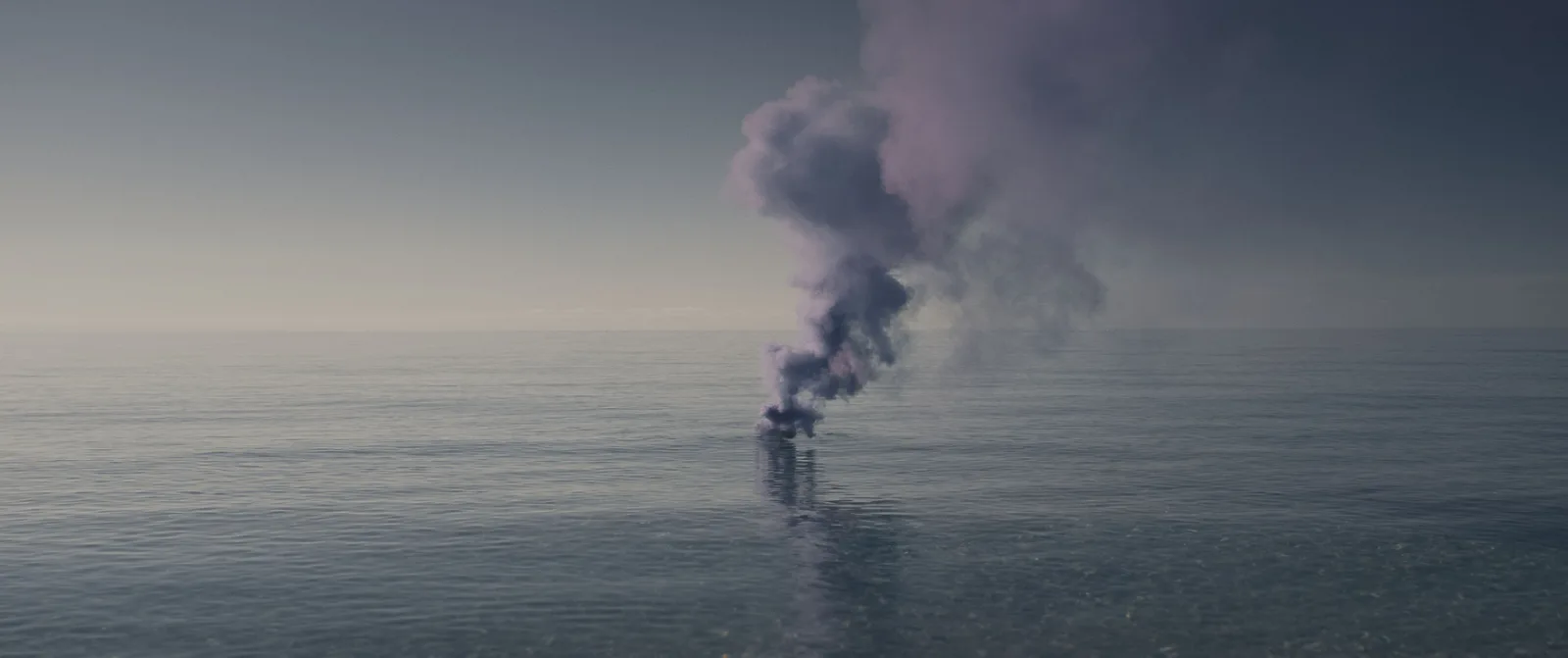
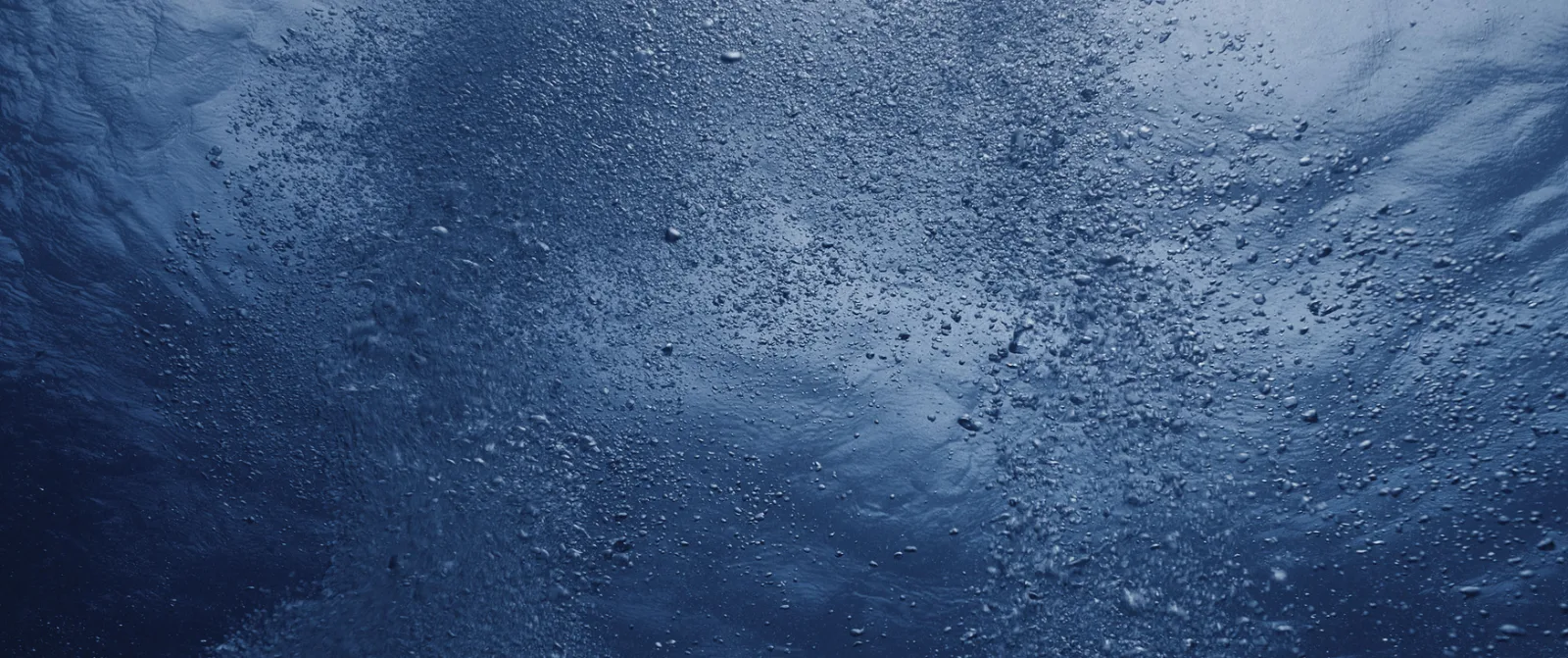
Behind both decisions stands the scholar Ariella Aïsha Azoulay, who, like Giardina Papa, is a faculty member at Brown University, and who writes about the violence of forcing everything to be shown and exhibited to the gaze. The film is about withdrawal. So the approach is oblique: other Sicilian volcanic formations, the underwater terrain around the Aeolian Islands, waters she has known since childhood. Matter that will not hold still: rising, dissolving, coming back up, always on the point of appearing and disappearing.
The Pretty and the Beautiful
Balsom then asks the question that the whole conversation turns on. The work is extraordinarily beautiful and openly seductive. Many experimental filmmakers have historically been suspicious of beauty. Giardina Papa evidently is not. Why does visual pleasure matter to her?
The answer arrives as a distinction, and it is the best thing in the talk.
She was not worried about the beautiful. She was worried about the pretty. Start shooting underwater and the pretty comes for free; it costs nothing. And the pretty, she says, you can colonise easily. You can grab it. The beautiful is harder, because it is "flickering and slipping in a way that the pretty is not."
The title of the work is the definition she has just given.
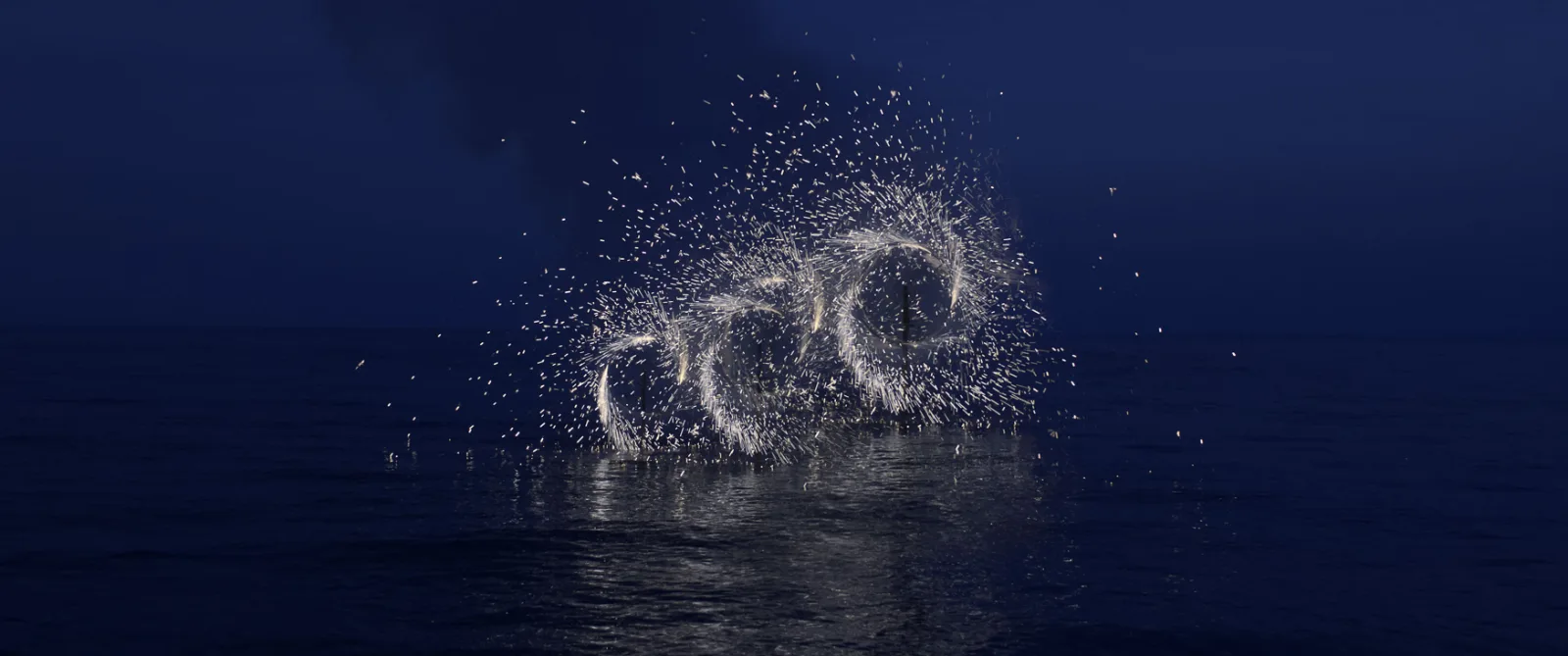
This is also the first time she has worked with abstraction, and she frames that as a technical consequence of a political decision. She wanted, she says, "the whole film not to be able to have an object that you could point to." Instead, unbounded matter that keeps moving without ever resolving into a shape.
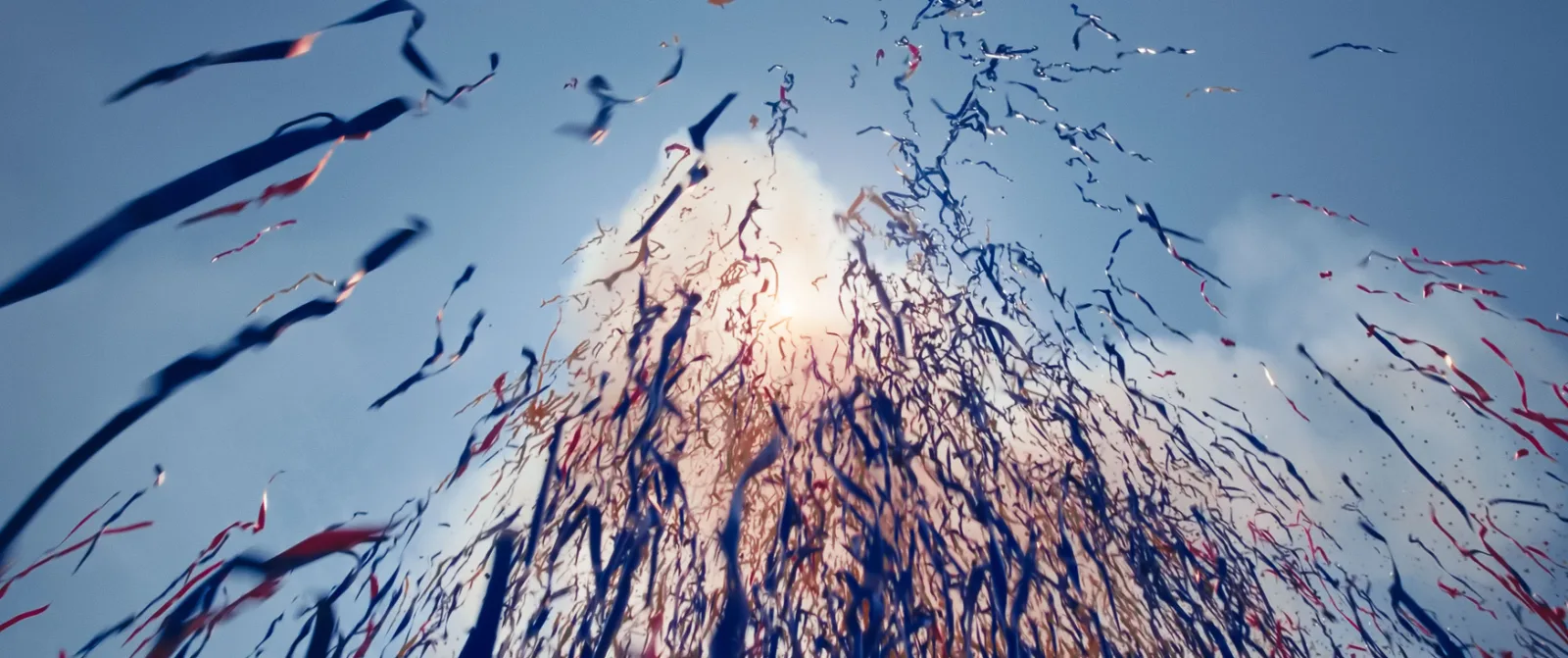
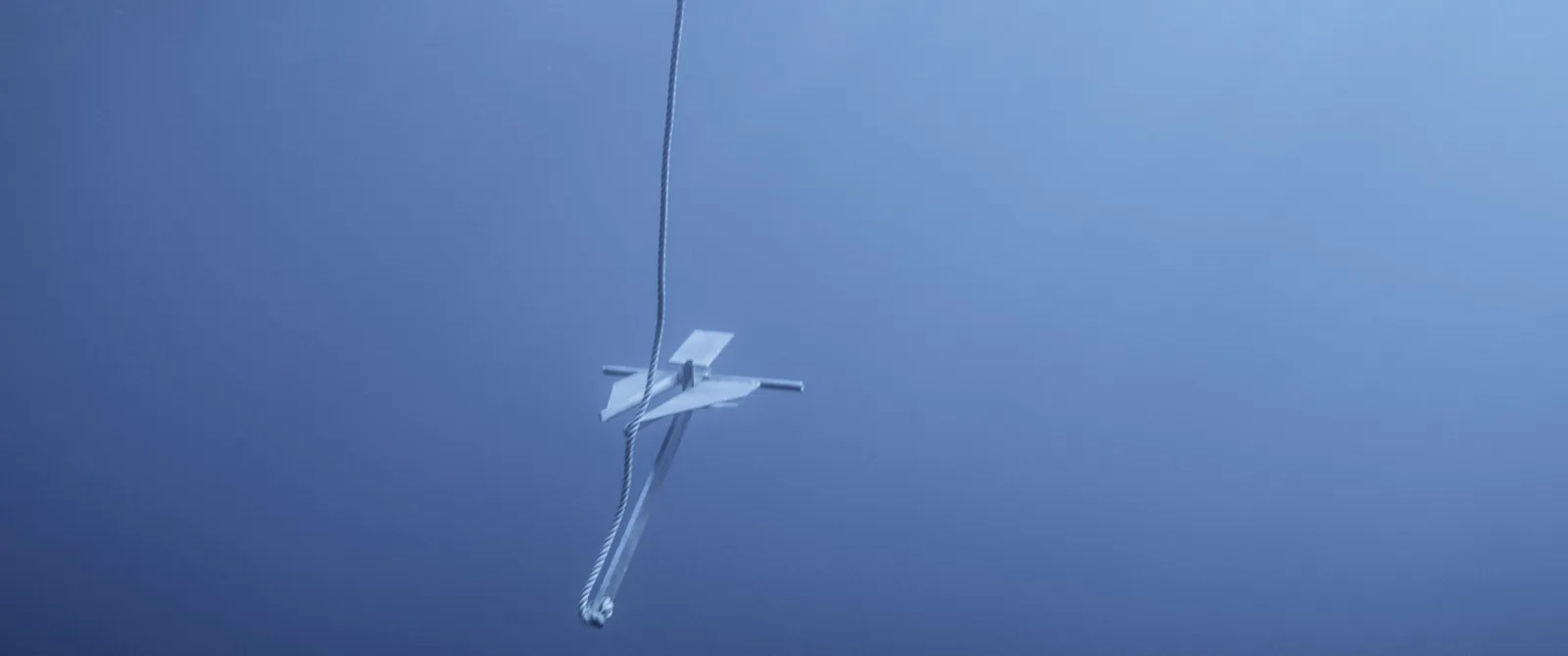
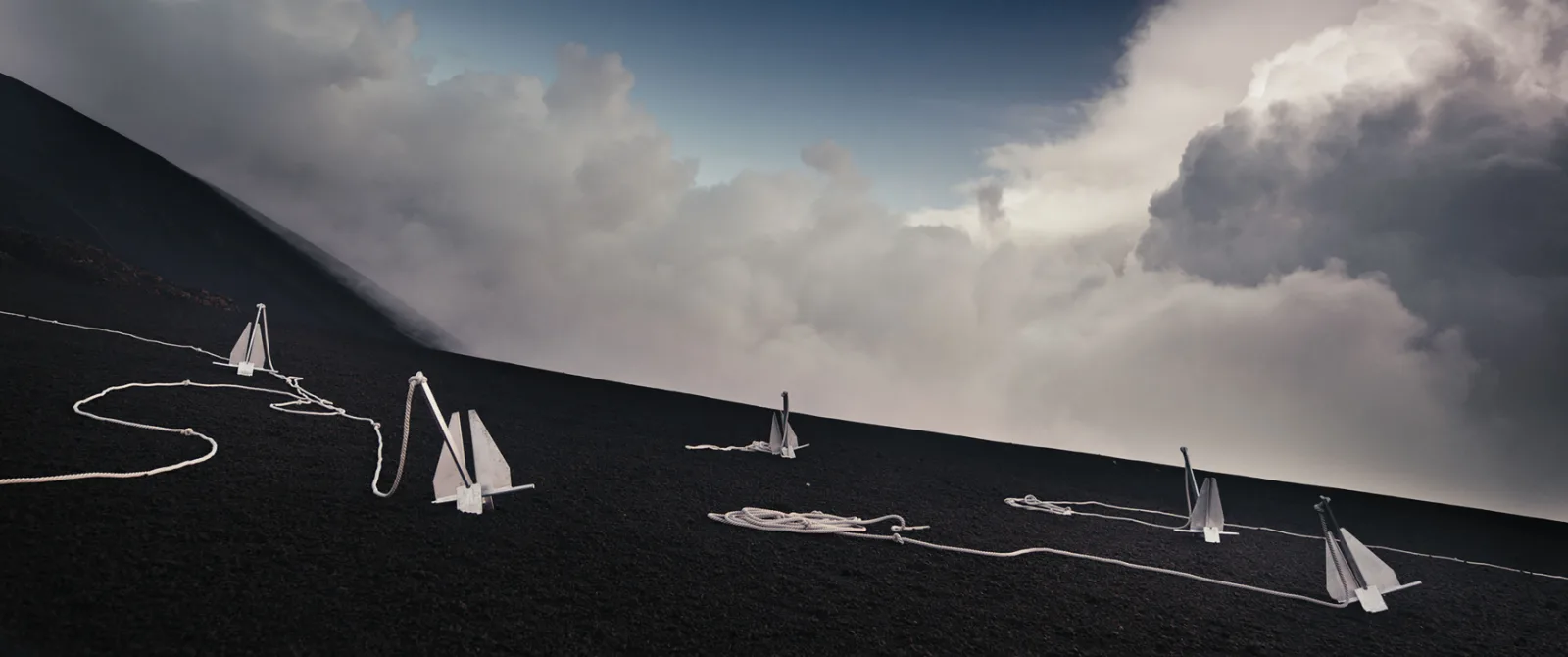
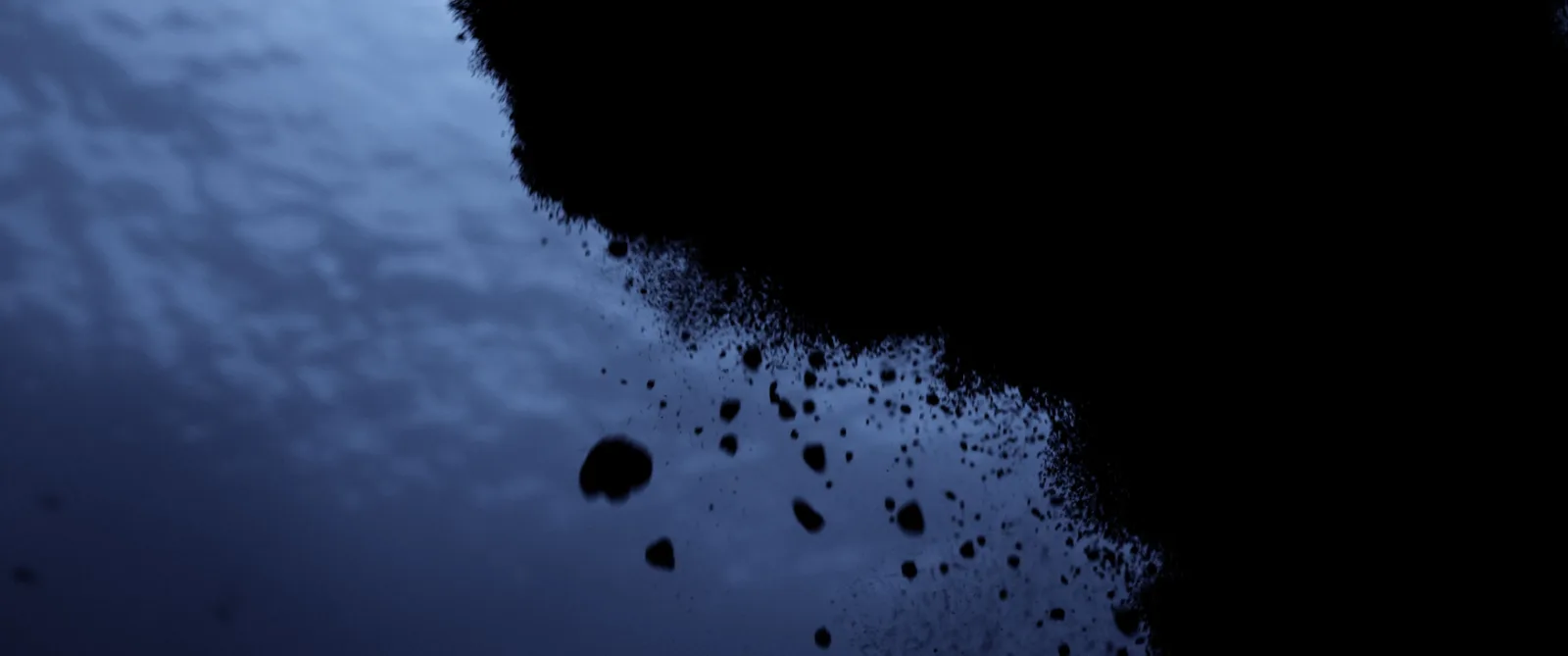
Fourteen frames from the film bear this out with a kind of stubbornness. Streamers bursting against a blue sky, an eruption made of paper. Anchors laid on black volcanic sand with white rope coiling across it, mooring gear placed where there is nothing to moor to. The same anchor suspended in blue with neither seabed nor surface in the frame. Black lapilli dispersing into water. Nothing that could be pointed at and named.
She Becomes We
The narration was written by the New York-based poet Megan Fernandes, whom Giardina Papa met at Brown after moving to the United States, and who wrote the first film in the trilogy as well. The working method is sequential: a year in the archive, a script, then a rough cut, and then Fernandes goes through the notes and drafts and finds the voice. The poem is translated into Sicilian by Elisa Puleo, whose work with the Cuticchio puppet theatre comes out of Mediterranean oral storytelling. What the audience hears is Sicilian. The subtitles are the poem.
Balsom asks about a grammatical decision: the island speaks as a she, and then as a we.
The she, Giardina Papa says, was a glitch that was already there, because Italian genders its nouns and isola is feminine. She and Fernandes met in Lisbon, watched the footage, and tried to write it as a she. It did not work. As soon as they switched to we, the film found a voice.
Then the reason, delivered quickly and almost in passing. "There is no politics without a we." And anyone who has been part of a movement knows that the we is never stable: there is a moment when a we forms, and then the energy dissipates, and the question of who is inside it and who is not remains open. That question stays open across the film.
Twice, at the beginning and near the end, the poem steps outside the island's timeline and names dates: the Stonewall riots of 1969, the Algerian War of Independence, Sidi Bouzid and the Tunisian revolution, Ni Una Menos. Moments when a structure of power takes a shock. The list emerged collectively among the people who made the film, and she is careful to say that a list is never conclusive. It can always be expanded and revised.
Balsom marks what is unusual here. Recent criticism of the non-human turn in theory has objected that people matter, that liberation movements matter, and that geological thinking can flatten them. This work holds both paradigms at once and lets them slip into each other rather than choosing.
Everything That Refused to Behave
There is a list running under this project of things that would not do as they were told, and she tells it as comedy rather than complaint.
Mount Etna was in near-continuous eruption through the summer of production, and the shoot had to be postponed repeatedly. In one sequence what appear to be clouds moving quickly across the frame are not clouds. She saw them and wanted to shoot; the scientist accompanying the crew told them to get down. They were gases.
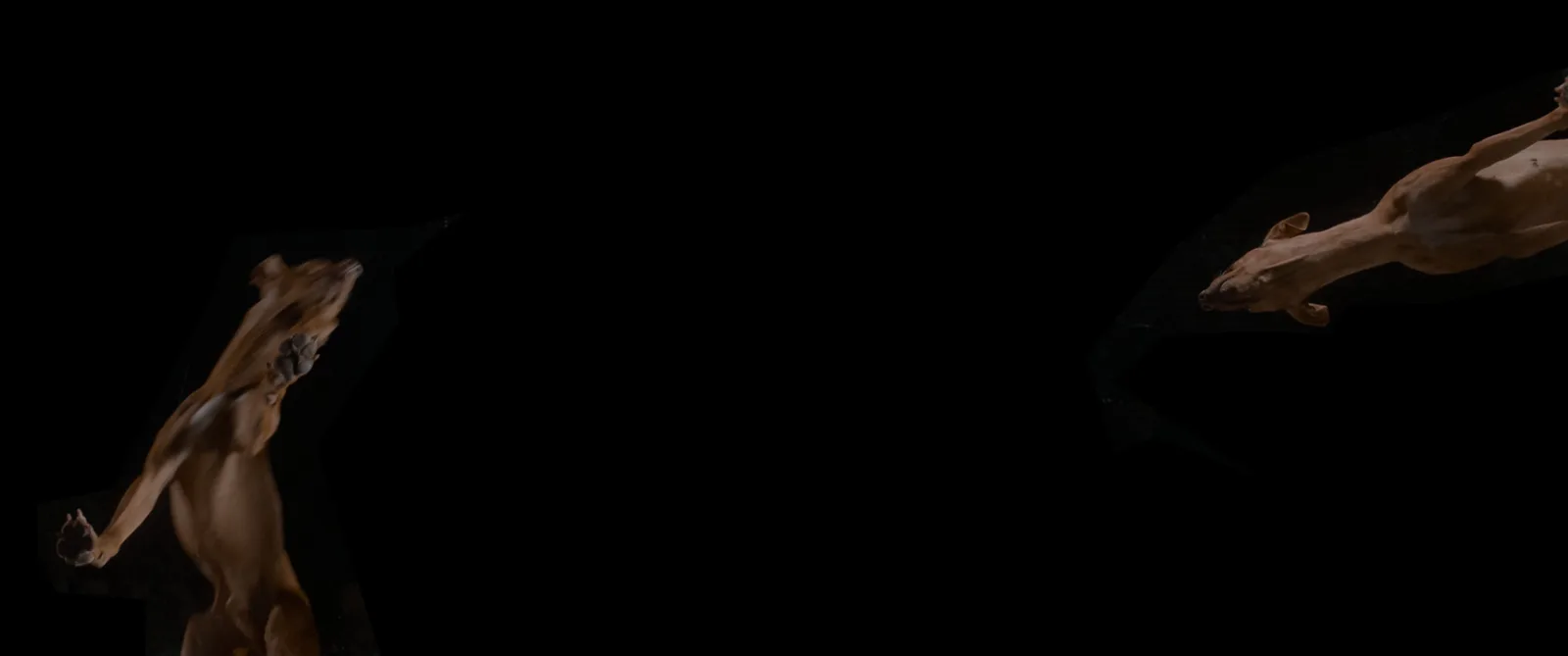
Then the dogs. A sequence in the film follows a Cirneco dell'Etna, an ancient Sicilian hunting breed adapted to the volcanic terrain and named after the mountain, filmed from beneath a glass floor so that the camera takes something like the island's point of view. The dogs would not walk. They could see their own reflection in the glass and refused to move, for two hours, with an expensive crew standing by. Only when the sun went down and the reflection disappeared did they begin to play. On U Scantu she had worked with a goat wandering through the rooms of a Sicilian Baroque palace, and had made a storyboard.
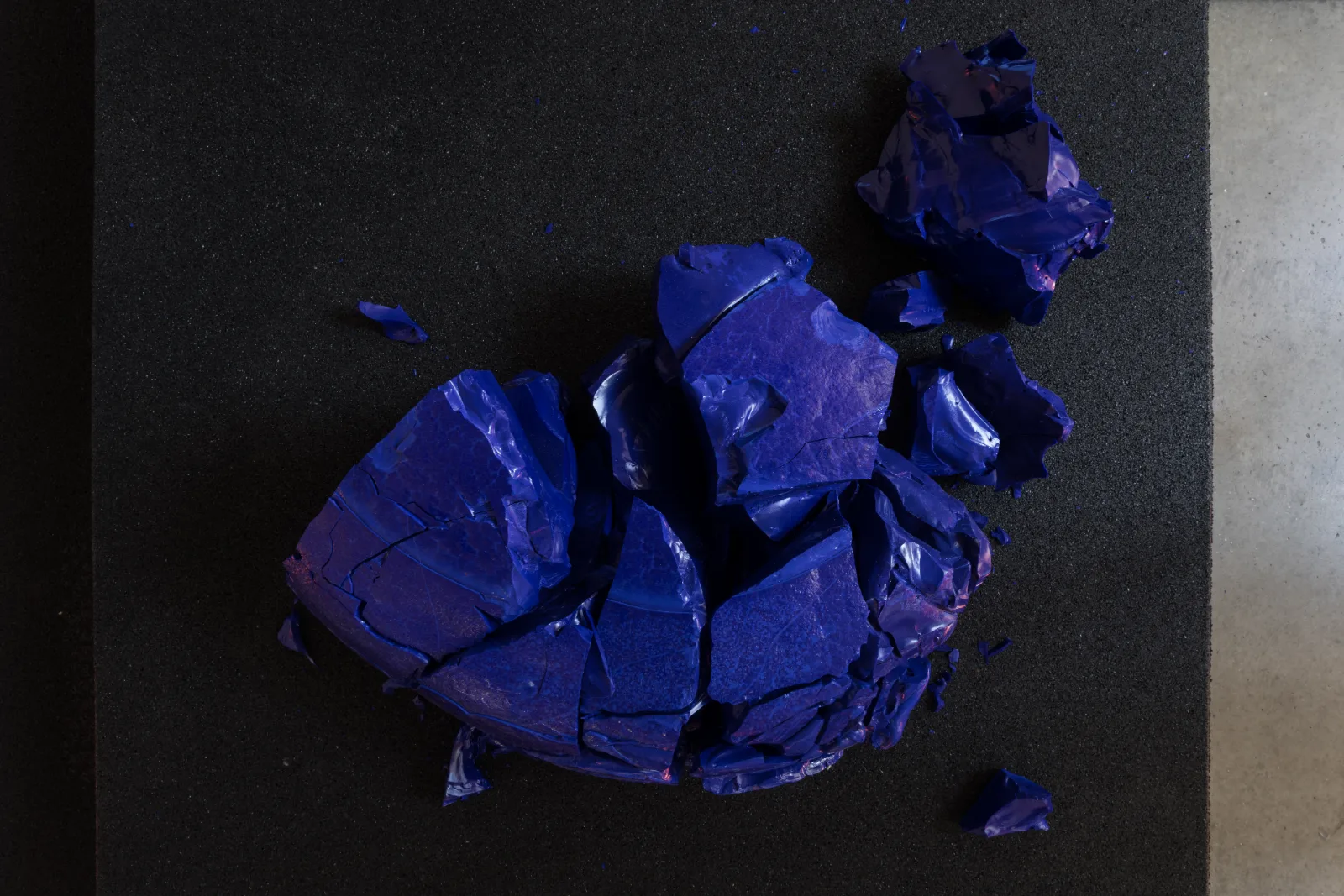
The sculptures are the same story in another material. Two months before opening, with the film finished and a different set of sculptures already produced, she raised the idea of cotisso with Nitsche-Krupp in Venice, who took to it at once and encouraged her to follow it. She went to Murano to take a look, and stayed a month. Cotisso is the raw first stage of Murano glass, poured into cooling bowls and overturned to break into pieces destined for remelting. She had loved the material for years and had always been told it could not be used, because it will crack and change shape whatever you do. Four hundred and fifty kilograms of it are now on the floor of the ICA. It cracks during the exhibition; a piece came away two days before the opening, and she says she is curious to see what shape the works will be by September.
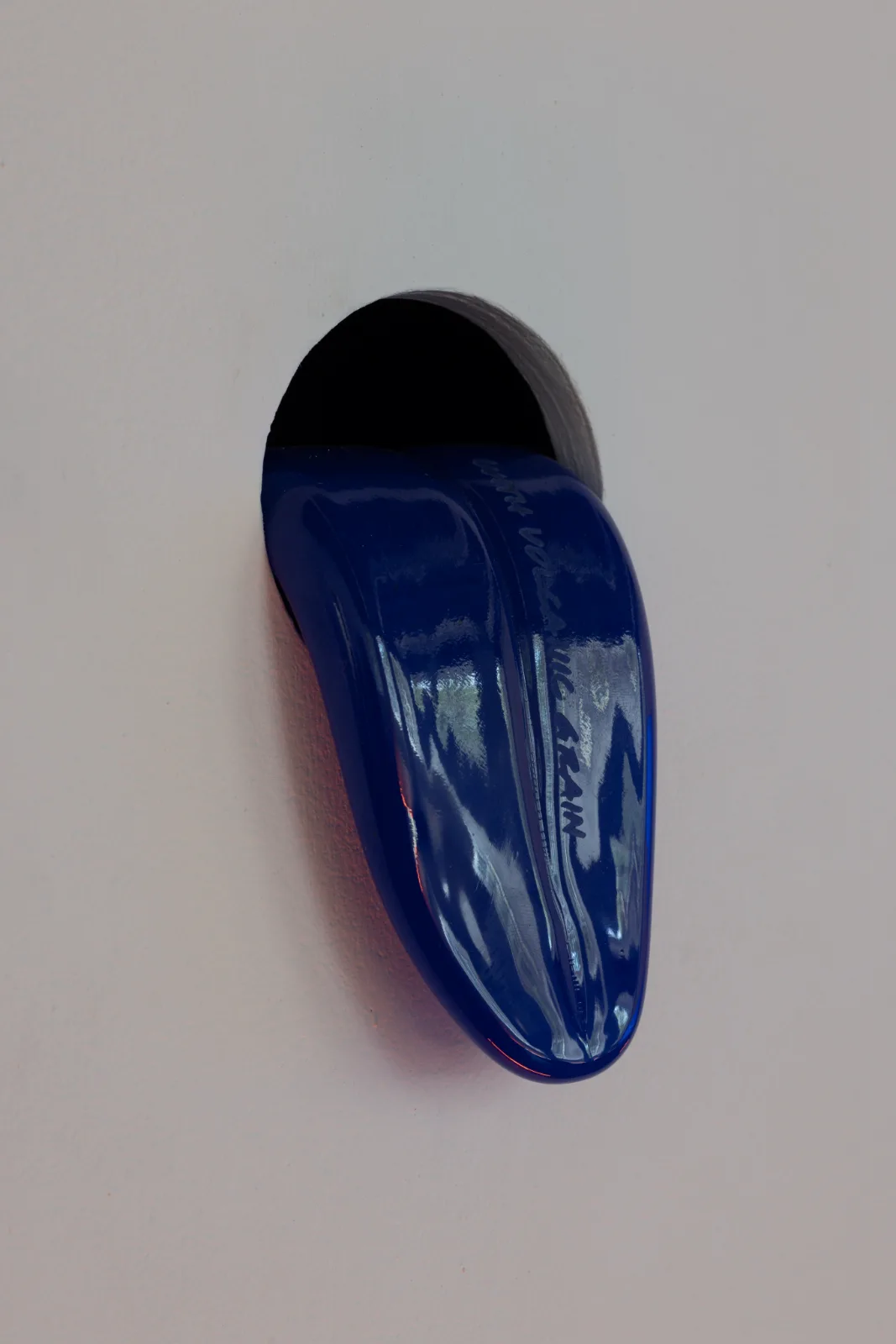
The tongues are the joke turned around. The Linguacce are hot-worked from stable glass, in a process designed to make them stable, and they broke twice in the annealing kiln. As she says in the gallery guide, whatever the material does becomes the work. In Italian a linguaccia is the insolent gesture of sticking out your tongue in refusal, the thing a child does when it does not want to do something. They emerge from circular openings in the gallery walls, inscribed with fragments of the poem, and she realised only while talking to her curator that they answer the nineteenth-century scientists who tried to know the island by tasting it.
A Room That Will Not Go Dark
The film has travelled: Bogotá, Naples, Taipei, Buenos Aires, Antigua, Rijeka. Almost always as a screening. The ICA is the first time it has had a space, and the time to think about one.
She is explicit about why this matters to her. She comes from video art. She begins thinking about the position of the spectator's body in a room before she starts shooting, not after. Given a choice, this is the ideal form of the work.
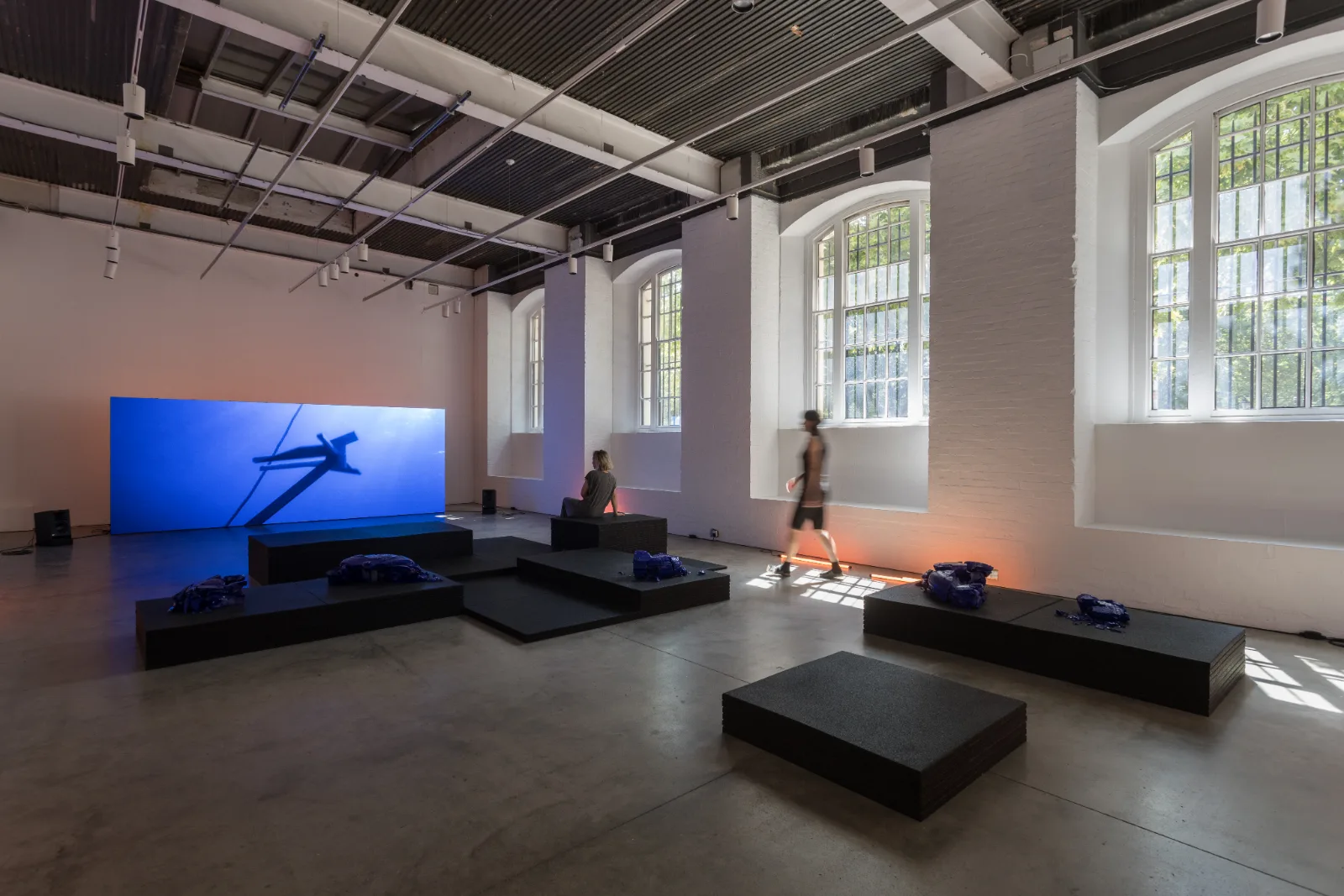
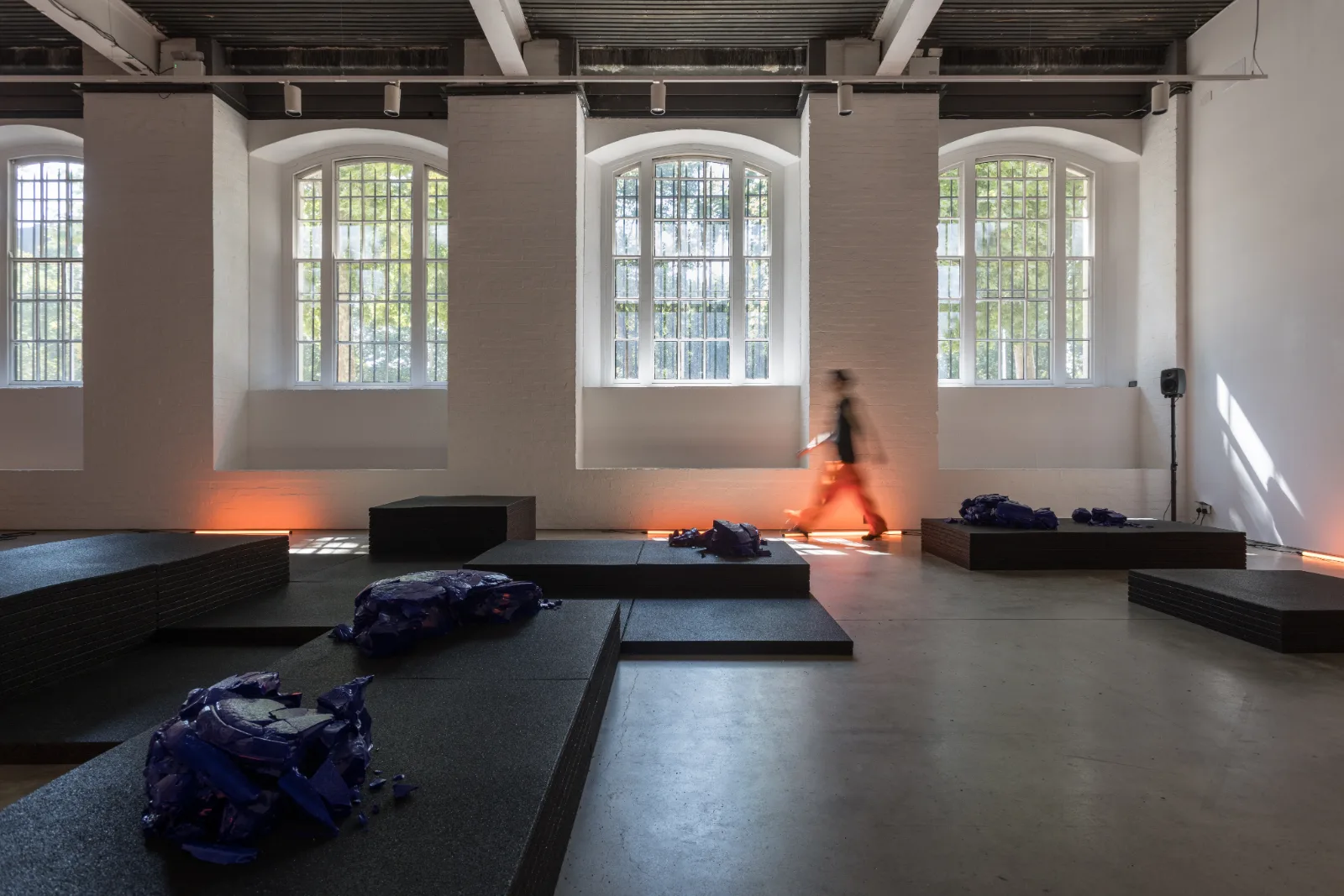
The design is by 2050+, whose founder Ippolito Pestellini Laparelli also has Sicilian roots Conceived in close dialogue with the artist, the scenography extends the film into the exhibition space, turning moving images into a bodily experience. Platforms of recycled black rubber are stacked in layers with the strata visible at the edge, referencing the black sand, arranged so that the blocks of glass sit in the room as spectators alongside the human ones. The cotisso watches the film. The people watch the film. The glass cracks.
The room is conceived as a changing environment. The gallery on The Mall has tall arched windows and full daylight, and the LED screen stands free in the middle of it. Rather than blacking out the windows, filters on the glass dim the daylight, so that the exhibition shifts with the changing light. On a July afternoon the sun lays bright rectangles across the concrete floor beside the glowing blue of the image. Along the skirting, orange neon tubes throw warm light up the white brick, so that the space is held between two colours: the blue of the screen and the sculptures, and the orange of the light. The two suns of 1831, the one that was reported and the one that should have been there.
A film about a thing that would not stay fixed, shown in a room that will not go dark.
The Cyclopes, and Who Gets to Play Ithaca
Balsom asks what comes next, and apologises for asking, because it is the standard question. Giardina Papa says it is her own fault: call something a trilogy and everyone assumes you know how it ends. She did not know what the second would be when she finished the first. She does not know what the third will be. She has notes, and she is not sure they will become a film.
The notes are about the Cyclopes. Rereading the Odyssey last summer, she realised that the Cyclopes are sometimes associated with the Sicani, traditionally held to be the earliest inhabitants of Sicily. Odysseus despises them. He describes a land that is magnificent and a people who do not know how to use it. In the terms of the poem they live outside nomos, outside the polis, outside techne: outside law, outside civic order, outside the skills of farming and navigation.
The rereading happened during a summer in which the Odyssey was also the reason she could not shoot. Christopher Nolan's film was in production across the Aeolian and Egadi Islands, and the hotels were full; her crew had nowhere to stay, and the shooting was postponed for that as well as for Etna. Nolan's Ithaca is Favignana, an island once called Aegusa, the island of goats, where Homer's Odysseus was thought to have landed to stock up on food. The Island of the Cyclopes was filmed in Greece.
A production of that scale arrived in Sicily and cast it as the hero's home. The Cyclopes, who may be the Sicilians, were shot somewhere else. Meanwhile a Sicilian artist thinking about the Cyclopes as the island's first inhabitants was looking for a room.
The Odyssey opened in cinemas on 16 July 2026. She Flickered In and Out of History opened at the ICA on 17 July.
A note on the programme: The installation is accompanied by a series of film screenings at the ICA, each programmed by a different guest: Iggy Cortez, Onyeka Igwe, Damon R. Young and Genevieve Yue. The last, on 2 September, is programmed by Giardina Papa herself with Valentina Manzoni.
Elisa Giardina Papa
Interdisciplinary artist. Lives and works in New York and Sant'Ignazio, Sicily. Her research-based practice seeks forms of knowledge and desire that have been disqualified and rendered nonsensical by hegemonic demands for order and legibility, working across large-scale video installation, experimental film, and ceramic and glass sculpture. She Flickered In and Out of History (2026) is the second part of a trilogy on overlooked Mediterranean histories, following U Scantu: A Disorderly Tale (2022), which premiered at the 59th Biennale di Venezia. Her work has been exhibited and screened at MoMA, the Whitney Museum of American Art, Gropius Bau, ICA London, Vienna Secession, HKW Berlin, Schirn Kunsthalle Frankfurt, Seoul Mediacity Biennale, the 6th Buenos Aires Bienal de la Imagen en Movimiento and M+ Hong Kong. She is a founding member of the artist collective Radha May with Nupur Mathur and Bathsheba Okwenje. MFA, RISD; PhD in Film, Media and Gender Studies, University of California, Berkeley.
Erika Balsom
Scholar and critic based in London, Reader in Film Studies at King's College London. Her work sits at the intersection of artists' film and documentary, with a focus on the histories, aesthetics and politics of nonfiction cinema and on the institutional conditions in which moving images circulate. Author of Ten Skies (2021), An Oceanic Feeling: Cinema and the Sea (2018), After Uniqueness: A History of Film and Video Art in Circulation (2017) and Exhibiting Cinema in Contemporary Art (2013). Co-editor of Feminist Worldmaking and the Moving Image (2022), Artists' Moving Image in Britain Since 1989 (2019) and Documentary Across Disciplines (2016). With Hila Peleg she co-curated No Master Territories at HKW Berlin in 2022. She holds a PhD in Modern Culture and Media from Brown University, is a member of the London Film Critics Circle, writes regularly for Frieze, Sight & Sound and 4Columns, and is a member of the ICA Independent Film Council and a former trustee of LUX.
Currently on view: Elisa Giardina Papa: She Flickered In and Out of History, ICA — Institute of Contemporary Arts, The Mall, London SW1Y 5AH, 17 July — 6 September 2026. Tue–Sun 12:00–20:00. Tickets from £6.00 / Pay What You Can £3.00 (12:00–13:00) / Members free. Curated by Andrea Nitsche-Krupp. Exhibition design by 2050+.
Talk citation: Elisa Giardina Papa and Erika Balsom, "Artist Talk: Elisa Giardina Papa in Conversation with Erika Balsom," artist talk moderated by Andrea Nitsche-Krupp, Institute of Contemporary Arts, London, July 18, 2026, https://www.ica.art/exhibitions/artist-talk-elisa-giardina-papa-in-conversation-with-erika-balsom
Related reading
The Art of Not Looking Away — a Dialogue from the ICA on class, capital and the image.
A House for Stories — the editorial manifesto of the Journal.
AnotherStory — curated films, portraits and visual trajectories.