It comes as a great shock to discover that the country which is your birthplace and to which you owe your life and your identity, has not, in its whole system of reality, evolved any place for you.
An Exhibition That Asks the Question No One Wants to Ask
There is a subject the art world prefers not to discuss. Not conceptually, not ironically, not even critically. It is the subject of its own relationship with money: who has it, who gives it, who makes art possible, and what that exchange does to the work itself.
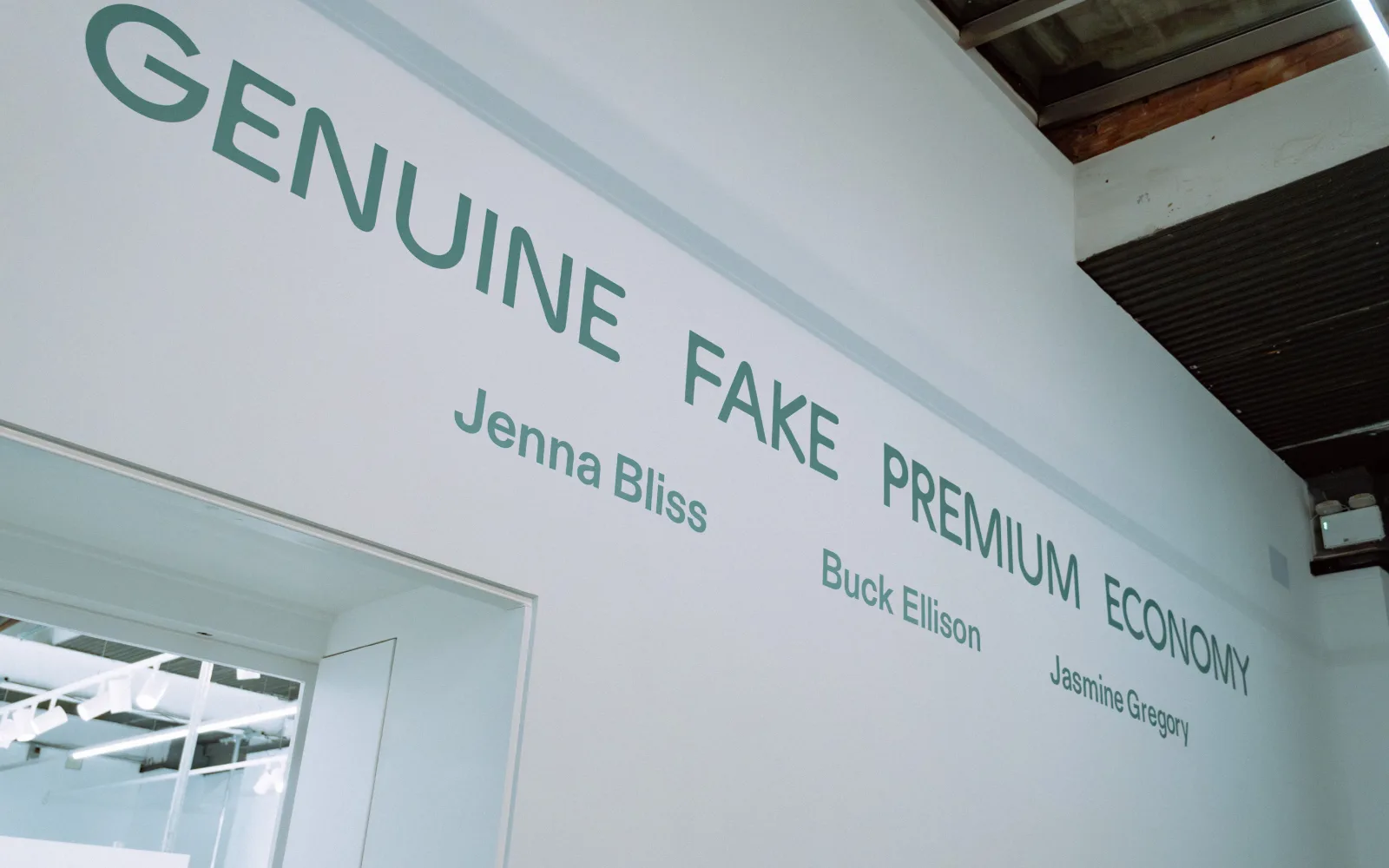
At the ICA in London, curator Nicola Leong brings together three American artists and places them in a room with that question. The exhibition is called Genuine Fake Premium Economy. The artists are Jenna Bliss, Buck Ellison and Jasmine Gregory. As Nicola has written: "Developing this exhibition with Jenna Bliss, Buck Ellison and Jasmine Gregory has raised thought-provoking questions about how this era of financial precarity has laid bare the myth of meritocracy. Each of them probes, with precision and wit, expedient narratives about work, aspiration and inequality, while reflecting on the uneasy relationship between art, money, labour and value."
They are all born in the mid-1980s in the United States. They all come of age in the wake of the 2008 financial crisis. They all make work that uses the visual language of capitalism — advertising, luxury branding, reality television, private banking — as raw material. And they are all aware, acutely, uncomfortably, sometimes hilariously, that they operate inside the very system their work examines.
What Nicola does is not simply group three artists by theme. She identifies a generational condition and gives it a stage. These are not artists who critique capitalism from a theoretical distance. They are artists whose biographies are shaped by its failures: a family home lost to foreclosure, a career in reality television taken because gallery internships do not pay, a life in Zurich because it is one of the few places where arts funding allows an artist to survive. The exhibition does not resolve these contradictions. It inhabits them.
We attend the preview on 30 April and the artists' talk on 2 May. What follows is drawn from that conversation: four voices thinking out loud about art, class, advertising, complicity and the strange position of making work about wealth in a world where the people who buy art are often the people the art is about.
Where the Conversation Begins: Biography as Material
Nicola opens the talk by noting that the three artists are connected not by medium or style but by biography. They are older millennials, American, but from different parts of the country, different backgrounds, different ethnicities. They do not know each other before the exhibition. The connection is generational: a shared experience of entering adulthood in a broken economy, and a shared instinct to make that experience visible.
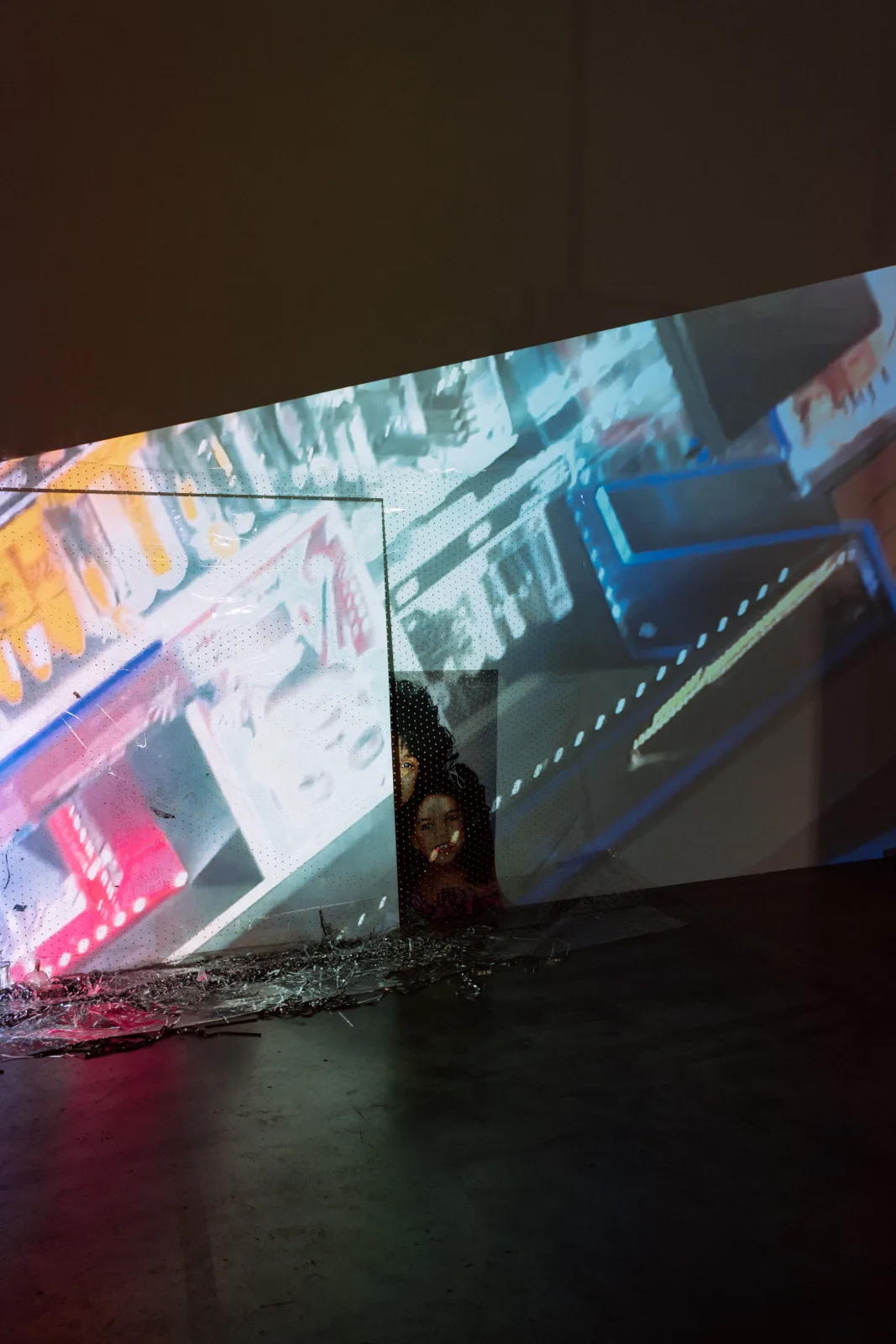
Jenna works in film and video. Her piece True Entertainment is a scripted reality television episode set inside an art fair booth in 2007, months before the crash. The cast — the unstable artist, the predatory collector, the performative art students — plays out the last hours of a world about to collapse. Her earlier work, Professional Witnesses, uses the visual language of early-2000s advertising to revisit September 11: the seamless white background, the clean typography, the aesthetic of cyberspace repurposed to frame an event that shattered everything those surfaces promised.
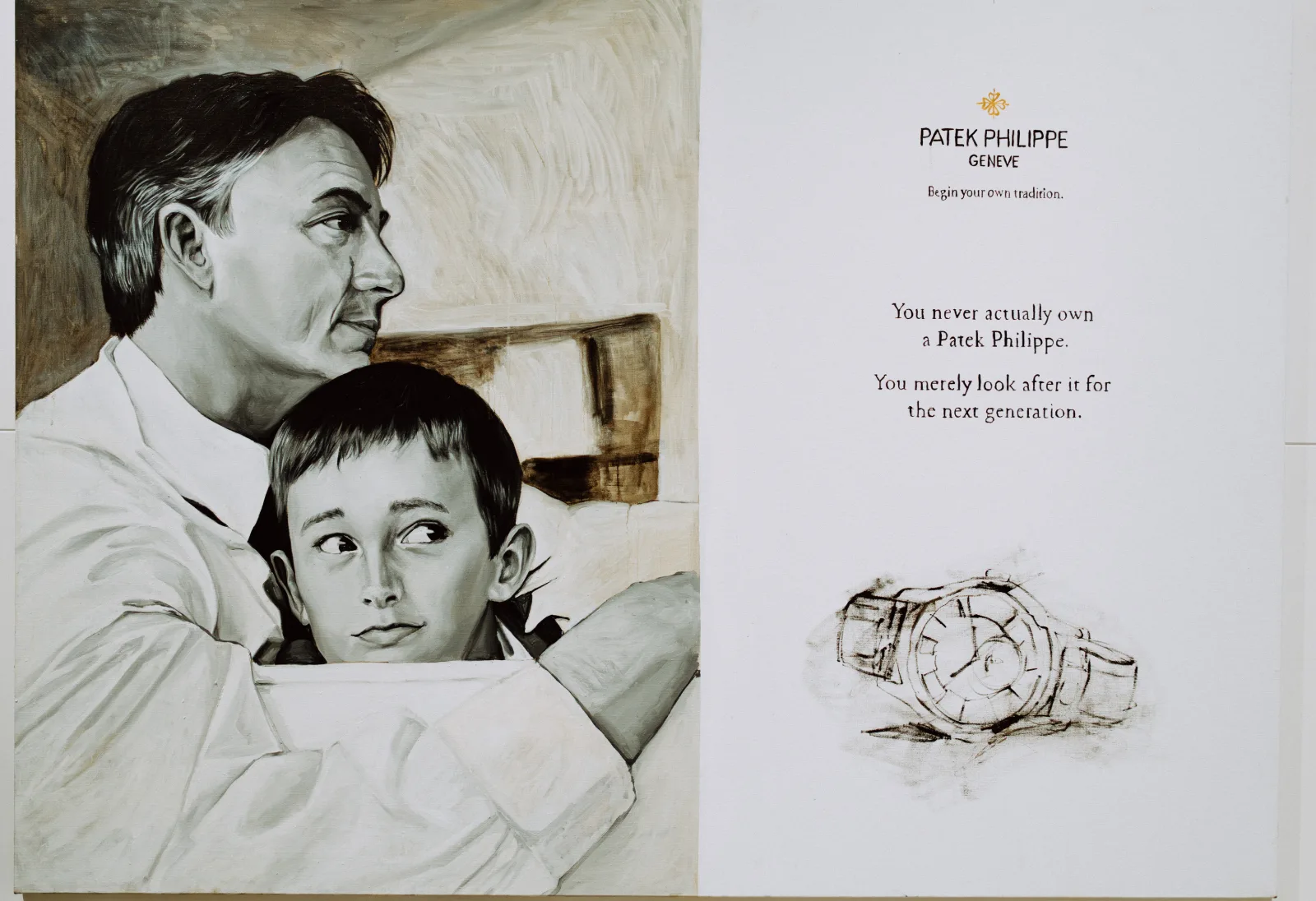
Jasmine paints. Specifically, she paints Patek Philippe advertisements: those images of parents and children, where a watch is never just a watch but a vessel for the transmission of power across generations. She reproduces them faithfully, by hand, on canvas, in greyscale, rendering father and son unnervingly stiff while blurring out the watches. The labour of painting becomes the subject. The gesture on the canvas mirrors the gesture in the ad: the careful, deliberate passing of something from one hand to another. What remains is the structure of inheritance itself, stripped of its object: "The watch is not there. Because it's not just the watch — it's something intangible, something that's more than the watch."
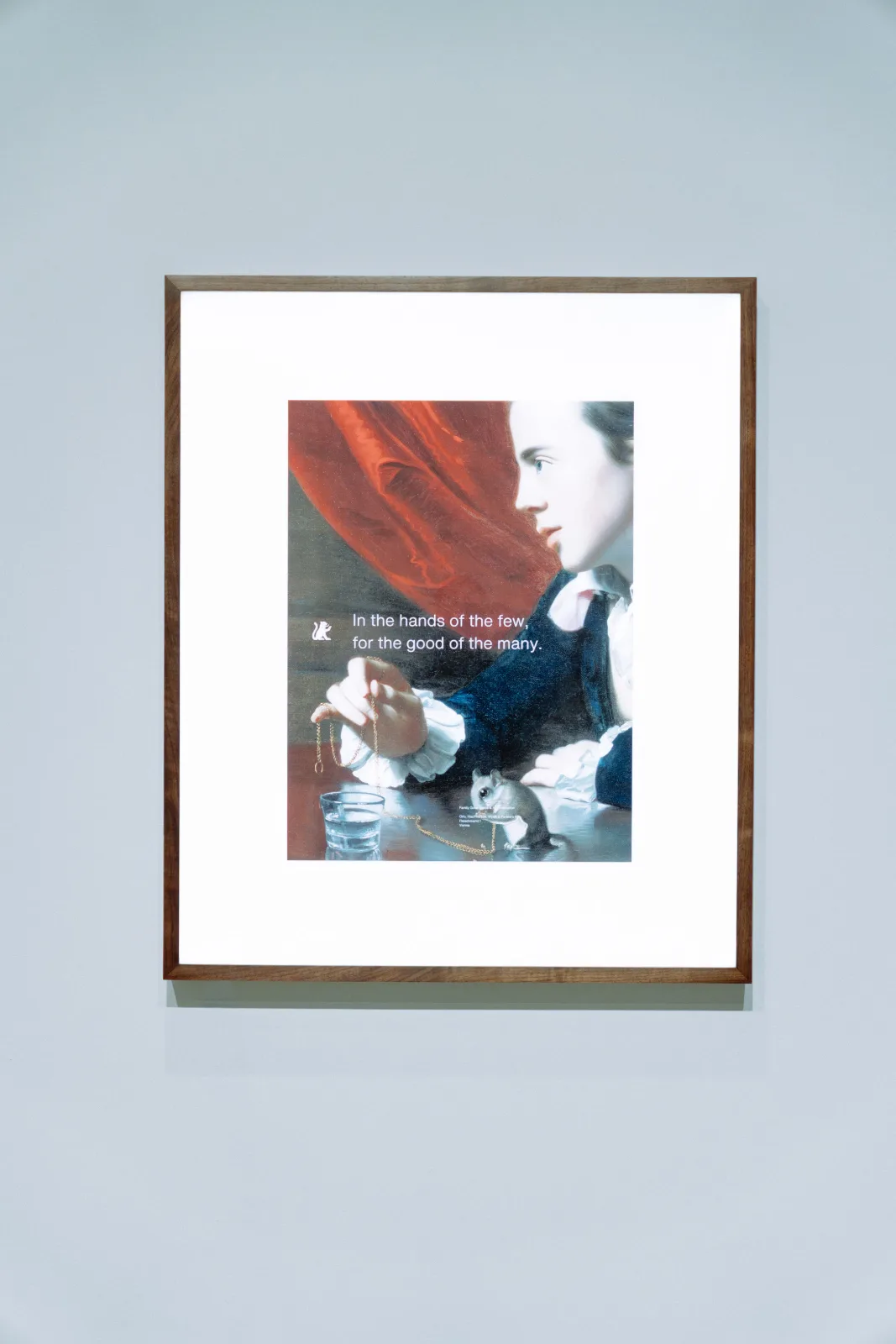
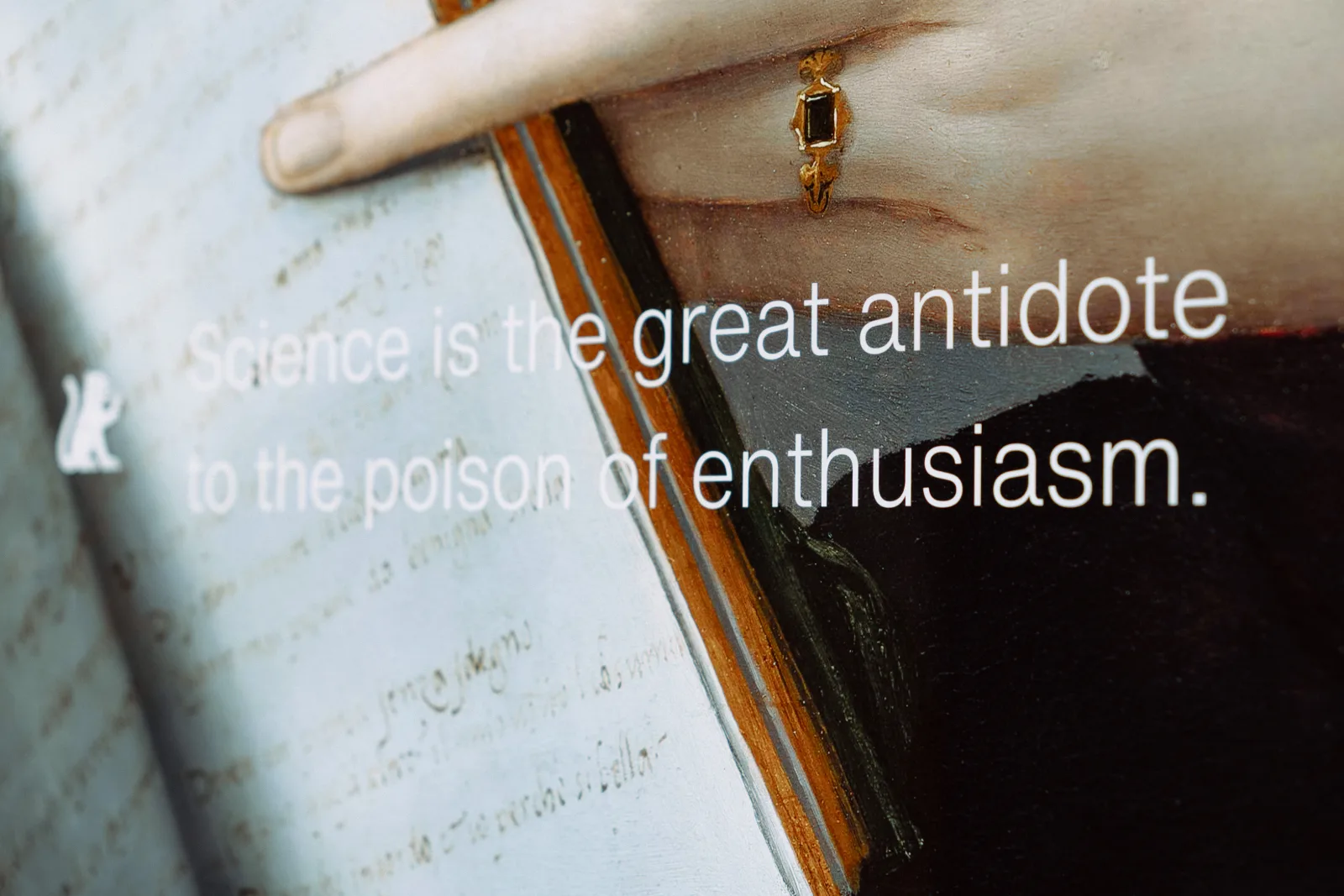
Buck builds fictions. For this exhibition he creates Orlo & Co., a private bank that does not exist: a complete graphic identity researched from thirty to fifty real private banks. "Banks love blue," he says. "The color theory that represents stability and evenness and a cool relationship to risk." The serif typeface is one founded in England in the 1750s, which would have been widely used around the time the bank was fictionally founded, in 1798. And then Helvetica: "the universal Swiss font of business from 1957. It cannot be beat." But what fascinates Buck about Helvetica is not its ubiquity, it is its transparency: "It's not just democratic and open, it's almost invisible. It cannot be pegged down. There's a nothingness to it." Invisibility as strategy. There are three walnut-framed advertising lightboxes with taglines that misconstrue adages from Scottish Enlightenment thinkers like Adam Smith, laid over images of historical paintings — a strategy Buck observes in private banking marketing material, where classical imagery seeks to manufacture institutional trust and legitimacy. "I was reading about a private bank whose motto was, I want to be invisible. These questions of massive amounts of money, compounding at these alarming rates that is completely invisible to us, is really scary and really interesting." Orlo & Co. makes the invisible visible by fabricating it from scratch. The fiction reveals the structure.
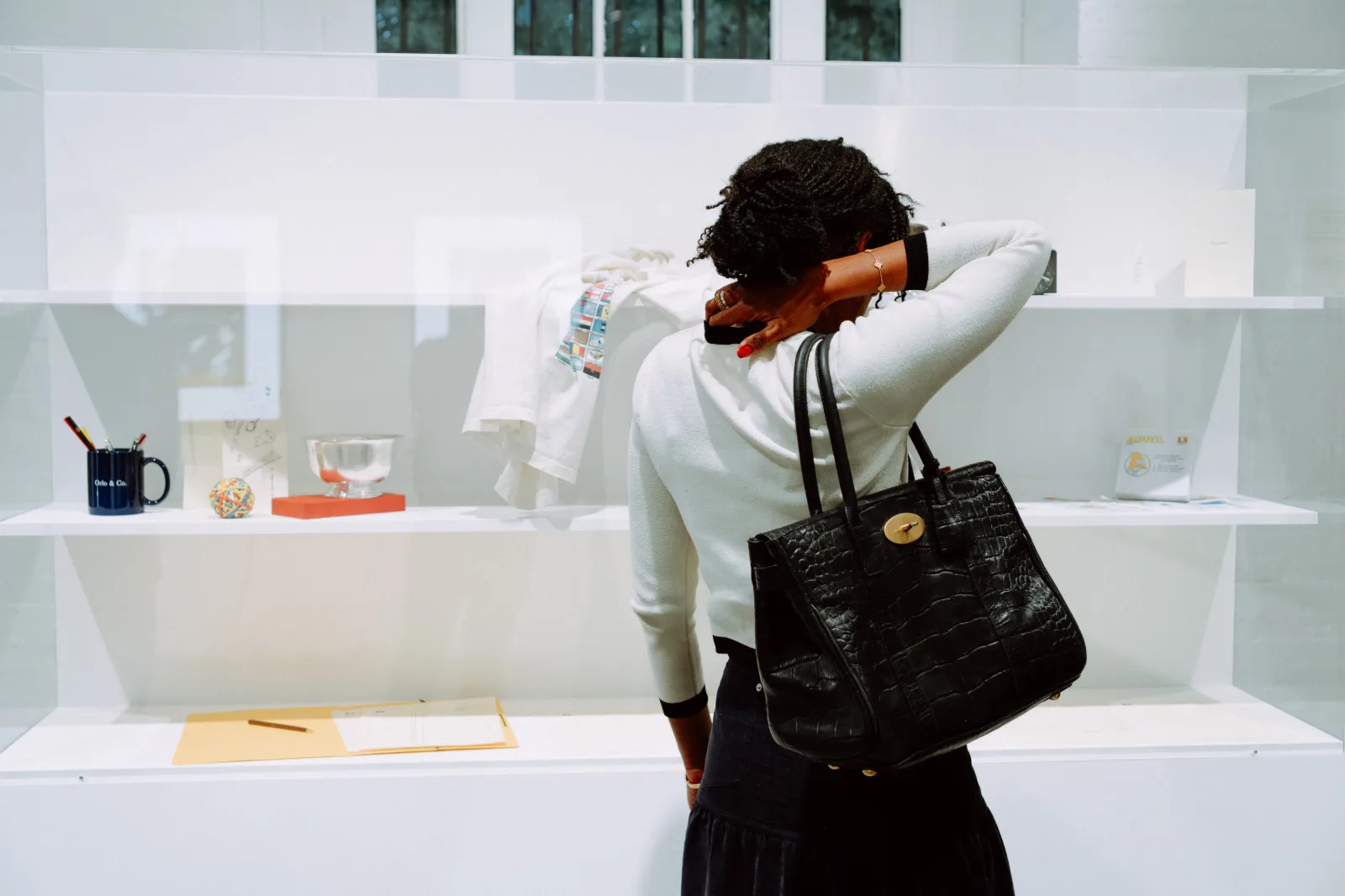
And there is an installation containing the desk objects of Jack, a fictional employee. We never see Jack. We know he is white. We know he went to boarding school. We know the notepaper on his desk comes from a luxury hotel in Paris. Buck is interested in what it means to be taught to take up space, to inhabit privilege correctly, to feel that luxury is deserved.
The Language of Advertising: Where Art and Capital Share a Vocabulary
One of the threads running through the conversation is the proximity between the language of art and the language of advertising. All three artists work with this proximity, but none of them treat it as simple appropriation.
Jasmine describes discovering the Patek Philippe campaigns and being struck by the fact that they were aspirational. "That's, quote unquote, the whole goal, if you will, for some people," she says. "And I was interested in painting them because of the labour." The ads are designed to be effortless, natural, seamless. The paintings make that effort visible. Every brushstroke is a reminder that this image of inherited ease is constructed.
Jenna talks about the visual codes of different eras of American capitalism. The seamless white backgrounds of early-2000s advertising, the reality television aesthetic of the mid-2000s boom, the shift from one grammar of aspiration to another. True Entertainment uses the format of The Hills, a scripted reality show about young adults in Beverly Hills: an all-white cast, mostly blonde, a California image of America that excludes by design. The art students who enter the fair in the film represent a different generation, a different visual register, a different set of assumptions about what success looks like.
Buck studies the graphic identities of private banks and discovers that their motto is, essentially, invisibility. Orlo & Co. makes the invisible visible by fabricating it from scratch. The fiction reveals the structure.
Complicity in the Room: Everyone in the Same Boat
The most striking part of the conversation is the moment when the artists stop talking about their work and start talking about their position inside the system they depict.
Jenna describes exhibiting in a space in Brooklyn whose founder has direct ties to the real estate and financial world of Manhattan, including the site where Occupy Wall Street began. Buck also notes having participated in several institutional exhibitions in America sponsored by major banks. "There is no purity on my part," he says. "I'm not able to point fingers from some distance." But distance is not what interests him. What interests him is proximity: "I think a lot about what it might mean to be a white man of a certain class, how you're taught to take up space." And then, with a precision that cuts: "The really wealthy people learn to get this sense that they deserve these luxuries, so that they can inhabit their privilege correctly.”
Jasmine speaks about living in Switzerland with a directness that cuts through every diplomacy. She talks about xenophobia, about the pressure to assimilate, about friends from immigrant backgrounds who navigate a system designed to make belonging conditional. "It really made me see how all of these things are put into play in a very direct way."
Jenna talks about the economic reality of being an artist. She works in reality television because galleries do not pay enough to live on. She is fired from a gallery internship because she cannot come in during the day, having worked nights on a TV set. "I couldn't afford to work in a gallery," she says. The sentence sits in the room like an accusation that implicates everyone present.
The Limits of Critique: Can Art Change Anything?
Near the end of the conversation, the question that has been circling the room finally lands. Can institutional critique work? Can art that critiques capitalism function inside the institutions that capitalism sustains?
Jasmine describes showing her Patek Philippe paintings and watching bank advisors look at them and laugh. "They loved it," she says. "You're not supposed to love it, actually."
Buck responds carefully. "I don't want it to be possible to be like, we figured out whiteness, guys. We're good." He does not want his work to offer the comfort of legibility, to become a commodity that allows collectors to feel they are on the right side of the critique.
Jenna goes further. "Our critique or protest or anger is for sale," she says. "That's also a commodity that could be purchased and then this oppressing class is like, we get it. We're in on the joke. We're not part of the problem. Look elsewhere."
And then, near the very end, she says something that changes the temperature of the room. She is asked about making new work. She hesitates. "I personally feel like I don't know how to proceed. I'm not really making any art right now." She mentions the fact that the aesthetic tools of critique and cinema are being used to create propaganda. "If those tools are being used for these other purposes, what am I left with?"
The question hangs. No one answers it. That silence is perhaps the most honest thing in the entire exhibition.
What We Take Away
Genuine Fake Premium Economy is not a comfortable show. It does not offer solutions, manifestos, or the satisfaction of righteous anger. What it offers is something rarer: the spectacle of artists thinking in public about the conditions of their own practice, without pretending those conditions are someone else's problem.
Nicola Leong has curated not just an exhibition but a conversation that needed to happen. By choosing three artists who share a generational experience but differ in medium, background and approach, she has created a space where the contradictions of making art under late capitalism are not resolved but held in view, examined, turned over, and left for the audience to sit with.
The works are sharp, formally precise, and often very funny. The talk reveals what the works alone cannot: the human cost behind the images, the biographical weight that gives the critique its edge, and the genuine uncertainty about whether any of it matters. That uncertainty, declared openly, in a room on The Mall, is itself a form of honesty that most art institutions cannot afford.
Jenna Bliss
(b. 1984, Yonkers, New York) Artist, filmmaker and video editor. Lives in New York. Her practice traces the intersections of financial systems, media formats and collective memory. True Entertainment (2023–24, HD video, 31:59 min) is a scripted reality television episode set in an art fair booth on the eve of the 2008 crash. Professional Witnesses (2024) revisits September 11 through the visual grammar of early-2000s advertising. Eurodollars (2024) documents New York's financial district through archival footage and scrolling text. Studied at the Slade School of Fine Art, London (MA, 2011). Recent exhibitions: Blue Light in the Living Room, Ulrik, New York (2025); Basic Cable, Amant, New York (2024); Haus am Waldsee, Berlin (2024). Represented by Felix Gaudlitz, Vienna.
Buck Ellison
(b. 1987, San Francisco) Artist working in photography, sculpture and installation. Lives and works in Los Angeles. His practice examines whiteness, privilege and the visual culture of inherited wealth through meticulously constructed fictions. For Genuine Fake Premium Economy he creates Orlo & Co., a fictional private bank with a complete graphic identity, three advertising lightboxes and an installation of desktop artefacts belonging to a fictional employee named Jack. BA in German Literature, Columbia University (2010); MFA, Städelschule, Frankfurt (2014). Collections: Carnegie Museum of Art, Hammer Museum, LACMA, Museum of Contemporary Art Los Angeles, Whitney Museum of American Art.
Jasmine Gregory
(b. 1987, Washington D.C.) Artist working in painting, assemblage and video. Lives in Zurich. Her practice interrogates the visual rhetoric of luxury, aspiration and the transmission of power through consumer imagery. She paints Patek Philippe advertisements by hand on canvas in greyscale, reproducing the compositions faithfully while making visible the labour the ads are designed to conceal. Deliver Us From Evil (2026) is a video installation. Conscious Uncoupling (Divorce) (2026) is a sculptural assemblage. Recent exhibitions: Who Wants To Die For Glamour, MoMA PS1 (2024); CAPC Musée d'Art Contemporain, Bordeaux (2023); Audacity Unlimited, Soft Opening, London (2025). Nominated for the Swiss Art Awards in 2023 and 2025. Represented by Karma International, Zurich.
Currently on view: Genuine Fake Premium Economy: Jenna Bliss, Buck Ellison & Jasmine Gregory ICA — Institute of Contemporary Arts, The Mall, London SW1Y 5AH 1 May — 5 July 2026 Tue–Sun 12:00–20:00 Tickets from £6.00 / Pay What You Can £3.00 (12:00–13:00) / Members free Curated by Nicola Leong, Associate Curator Supported by The Swiss Arts Council Pro Helvetia
Read on AnotherStory Journal
A House for Stories
The Journal is the place where AnotherStory thinks aloud — where films find context, projects take shape, and stories continue beyond the screen. Not a blog, not a magazine: a living archive, a house for the eye that learns to stay.