To her was attached a whole wobbling balloon of air-balls. She held this billowing, always moving, most desirable mass by one string. They glowed in my eyes always red and purple (…) For a penny, she would detach one from the bellying soft mass, and I would dance away with it.
The Walk Before the Gallery
We arrive at Kensington Gardens before the gallery. This is not by chance.
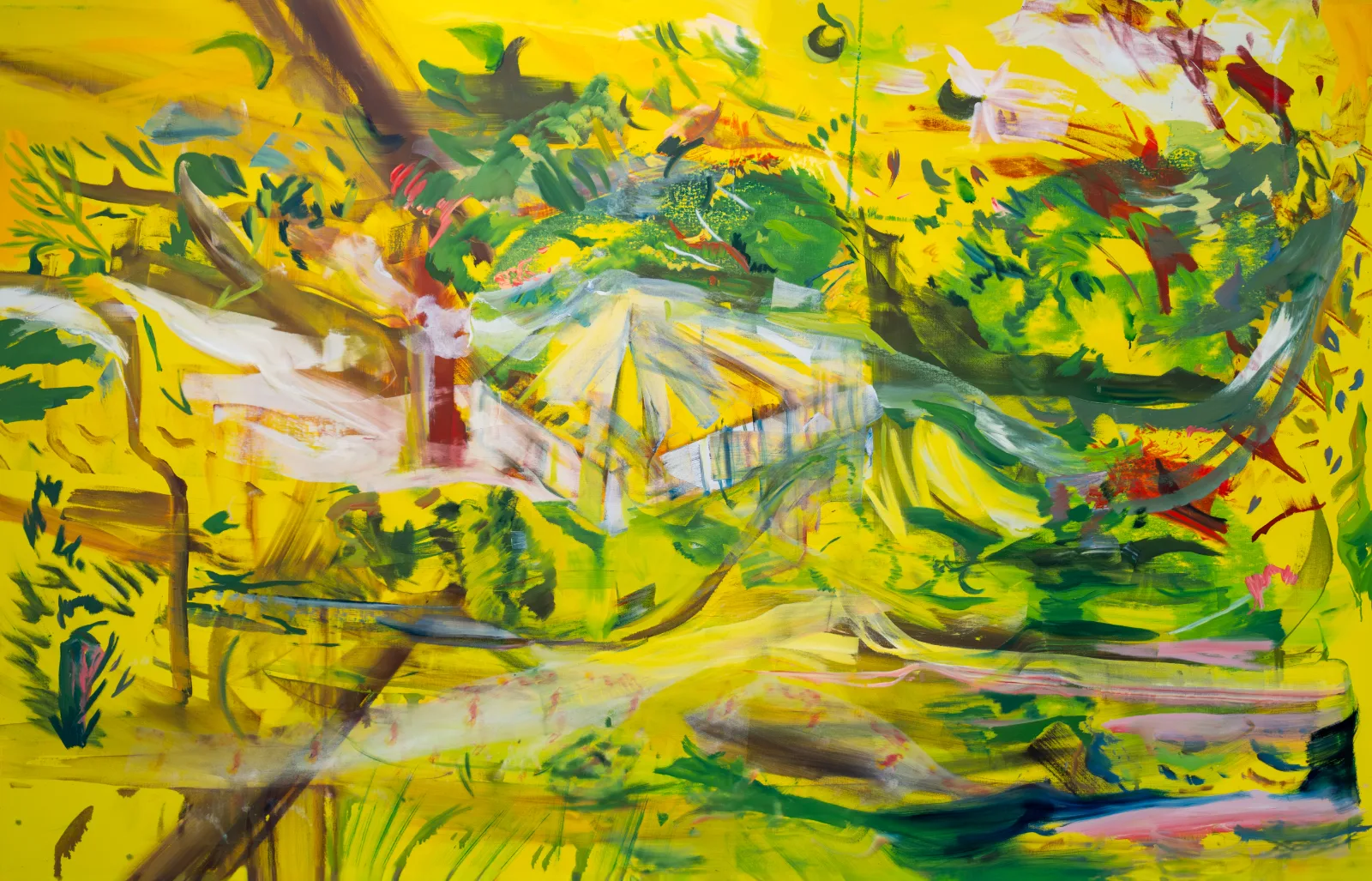
It is a way of entering a painting exhibition that begins in the very act of crossing the gardens, immersed in the vivid, vibrant colours of lawns, trees, plants, flowers. Our visual path does not start at the gallery door but a mile before it, on foot, walking through the natural scenery the paintings describe. At Serpentine South, where Cecily Brown's Picture Making occupies the airy pavilion until September, the park is not a frame. It is a landscape that envelops and comes alive. It spills out of the paintings, enters the gaze of the visitor, accompanies you as you walk and retrace everything your memory has captured in the canvases. A log, a tree, a river. All the colours of a nature walk (Nature Walk with red yellow blue, The charmed water, Nature Walk with Paranoia). The gallery itself lights up with green and yellow in The Serpentine Picture. The paintings inside were made with these gardens in mind, and the gardens outside define a visual itinerary with images that imprint themselves on the memory before you even reach the first canvas.
It is early May. The light has that quality peculiar to English spring: not warm, not cold, present without insisting. The South Flower Walk is in its first blooms. We observe every detail to capture it with the camera, drawn to the shapes the light returns through the canopy of trees, to the way a path curves into shadow and reappears in colour. We follow the route slowly, watching, shooting, breathing it in. An itinerary of light and colour that activates all the senses, beyond sight alone. And the senses awaken memory. How many stories this place has to tell: a garden walked for nearly two centuries, the same paths taken by different feet, the same trees watched by different eyes.
Virginia Woolf walks here as a child. Twice a day, with her father, from 22 Hyde Park Gate across the road and into the gardens. She writes about it decades later, in A Sketch of the Past, the memoir she begins in 1939 and never finishes: the long stories she and her siblings invent to pass the time on those slow walks, the repetition that becomes, without her knowing it, the material of everything she will write. What in childhood is an obligation becomes for the writer a lasting source of what she herself calls, in her diary, the greatest happiness: walking through a London park, making up phrases.
We find her on a panel in the South Flower Walk: The Magic of Kensington Gardens. A small information board, placed among the flowerbeds, with her photograph and a passage from the memoir. The gardens remember their writers. They hold them in place, literally, between the flowering borders.
Inside: Picture Making
Cecily Brown's paintings do something that is difficult to describe and impossible to photograph. They move. Not literally, but perceptually: the surface shifts as you look at it, figures appear and dissolve, a landscape becomes a body becomes a tangle of colour becomes a landscape again. The artist has described the experience she seeks as something like having a word on the tip of your tongue without being able to recall it. A sensation conveyed in the perception of a suspended, unresolved gesture: the attempt to grasp.
The exhibition at Serpentine South is called Picture Making, and it marks a homecoming. Cecily is born in London in 1969, studies at the Slade, and has lived in New York for thirty years. This is her first major solo presentation of paintings in a UK public institution since Modern Art Oxford in 2005. She chooses to make the new works for this show in direct response to Kensington Gardens, a place she returns to throughout her formative years and that holds a particular charge for her. The park is not a backdrop. It is the subject, portrayed through her memory as it becomes painterly gesture.
What we see: a series of "nature walk" paintings that rework the same image across different scales, formats and palettes. The starting point is a jigsaw puzzle illustration of a fallen log bridging a stream. Brown takes this modest source and subjects it to infinite variations on the theme, each canvas is a new attempt to find what the image contains. Elsewhere, couples entwine in woodland settings that blur into abstraction. Bodies merge with nature itself: leaves, plants, flowers, streams, trees. The boundary between flesh and leaf is erased not by intention but by the painting, which does not distinguish between what is human and what is not.
There is a painting called Couple from 2003–04 that borrows the sensual excess of Rococo painting and introduces chaos. There is The Serpentine Picture from 2024, made specifically for this place. There are drawings and monotypes drawn from Beatrix Potter, from Kathleen Hale's Orlando the Marmalade Cat, from vintage Ladybird books: animals as stand-ins for human experience, childhood illustration as a gate back into the body of painting.
The Walk After the Gallery
We leave Serpentine South and walk back into the gardens. The same path, the same light, but our way of looking has changed. This is what a good exhibition does: it recalibrates the eye and sharpens perception. The foliage that was foliage on the way in is now also paint. The shadows under the trees have acquired the density of brushstrokes. The Long Water, glimpsed through branches, looks composed.
We walk carrying the afterimage of Brown's canvases into the real garden and watching the two things merge into one another, generating a further, different image: "the visual image," as Italo Calvino might have called it. This is what a Visual Trajectory is: not a review, not a report, but a record of what happens when images from different sources converge in a single walk, united through stories, places, time. A painter who grows up walking these paths. We who photograph them for the first time with a different gaze. A writer who walks them every day as a child and from that repetition draws a way of seeing that changes English literature.
Virginia Woolf writes in her diary that the greatest happiness in the world is walking through a London park, making up phrases. Cecily Brown has said that painting is an "in-between, surrogate world," a space where we are free to try on interpretations. Between the phrase and the brushstroke, between the word and the image, there is the garden. It holds them both. It holds us all.
Currently on view: Cecily Brown: Picture Making Serpentine South, Kensington Gardens, London W2 3XA 27 March — 6 September 2026 — Free
Also at the Serpentine: David Hockney: A Year in Normandie — Serpentine North
Read on AnotherStory Journal
A House for Stories
The Journal is the place where AnotherStory thinks aloud — where films find context, projects take shape, and stories continue beyond the screen. Not a blog, not a magazine: a living archive, a house for the eye that learns to stay.